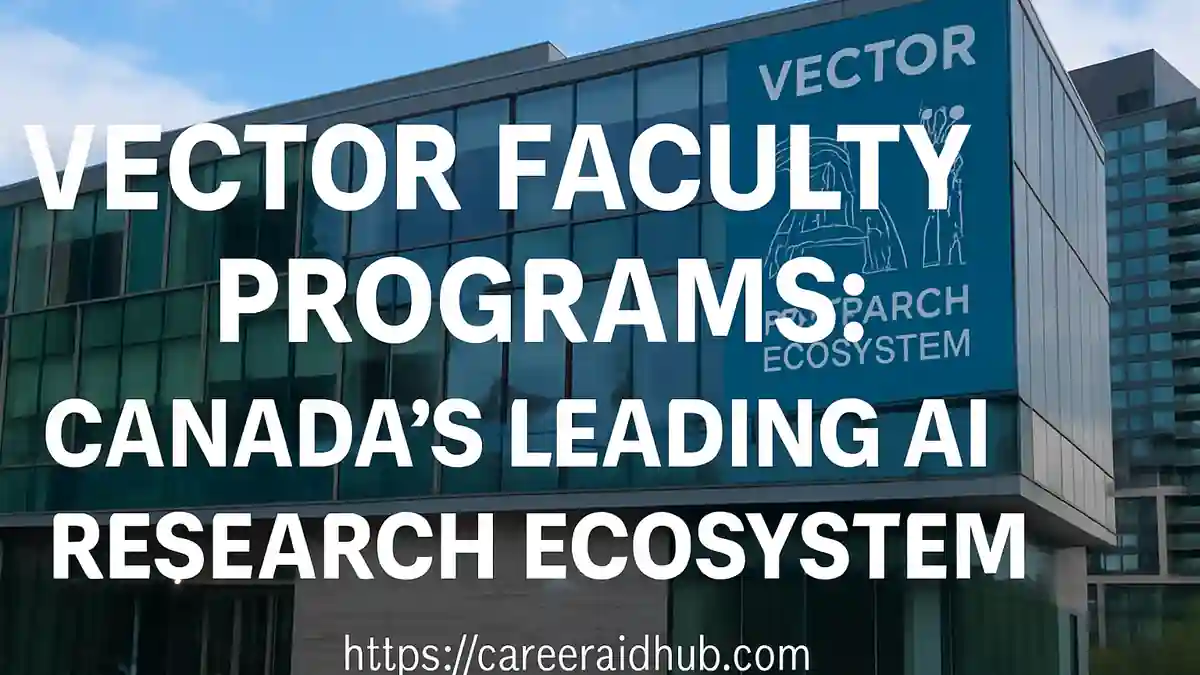
Canada has built one of the world’s most visible academic AI ecosystems, and the Vector Faculty Program sits at the centre of that momentum. If you are a machine learning researcher who wants stronger collaborations, better compute access, and deeper links to industry and health partners, the Vector Faculty Program in Canada’s leading AI research ecosystem deserves a close look. This article explains what the program is, who it is for, what benefits matter in practice, and how to position yourself for a successful application. You will also find selection-style insights, an application-ready checklist, and common mistakes to avoid.
Introduction and overview
The Vector Institute for Artificial Intelligence (based in Toronto) runs a faculty membership model designed to help globally recognised researchers increase research impact through collaboration, infrastructure, and ecosystem support. Vector’s faculty programs bring together researchers across institutions, not only in Ontario but also across Canada, creating a community that supports discovery and translation.
Importantly, this is not a single “job posting.” Instead, it is a structured membership framework that can include different forms of affiliation and collaboration. In the sections below, you will learn how the program works, what Vector highlights as key value, and how to prepare an application narrative that fits the ecosystem.
Why Vector Faculty Programs matter for AI researchers
justify;">
A research community designed for collaboration
Vector describes its faculty membership model as a way to create “optimal conditions” for researchers to advance their work through collaboration and discovery. In practical terms, that means exposure to new co-authors, shared seminars, and problem-driven engagement with partners.
For many faculty members, the real advantage is not a single resource. Instead, it is the combination of community, infrastructure, and pathways to real-world deployment. If your research spans multiple disciplines—such as health, climate, or responsible AI—ecosystem proximity often improves both publication velocity and impact relevance.
Stronger compute pathways and national infrastructure context
Vector states that faculty members receive priority access to a high-performance computing environment and that Vector plans to scale compute resources for high-impact research in 2026. That matters because modern deep learning research depends on reliable GPU access, reproducible workflows, and technical support.
Canada is also building broader research compute capacity through collaborative initiatives. For example, Mila’s public update on the TamIA cluster describes the Pan-Canadian AI Compute Environment (PAICE) as an effort created under Phase 2 of the Pan-Canadian AI Strategy to deliver dedicated national AI infrastructure and related services. While PAICE is not the same as Vector’s internal compute resources, it signals a national direction: research-grade AI compute
is becoming a strategic priority.
Visibility that supports citations, talent recruitment, and partnerships
Vector explicitly highlights that it amplifies research contributions through its website, blog, social media, newsletters, and conference presence. For faculty, this kind of visibility can improve lab recruitment, invite pipeline strength, and partnership discovery. It also helps when you compete for national and international grants, where evidence of research translation and community leadership often matters.
Who the Vector Faculty Program is for
Typical profile and fit signals
Vector’s faculty programs are positioned for researchers with strong AI research credentials who want to increase collaboration and impact. The program language emphasises globally recognised researchers, ecosystem engagement, and discovery-oriented work.
In practice, “fit” often looks like this:
-
- A clear research agenda in machine learning or closely related AI fields
- Strong evidence of peer-reviewed impact (publications, citations, or widely used methods)
- A lab-building or mentorship focus, including graduate and postdoctoral supervision
- Readiness to collaborate across institutions and with applied partners
For international and India-based researchers
If you are based outside Canada, treat the Vector Faculty Program as a target for medium-term planning rather than a quick application. A common route is to build Canadian collaboration first. For instance, you might co-supervise, co-author, or co-propose a project with a Canadian institution that already works with Vector’s ecosystem.
If you are an
India-based faculty member aiming to enter Canada’s AI research network, focus on credibility signals that translate globally: reproducible research artifacts, open-source contributions, strong student outcomes, and well-defined research themes with societal relevance.
Key features and highlights to know
Faculty scale and ecosystem breadth
Vector’s Faculty Program page provides a snapshot of its research community size, including counts for faculty members, faculty affiliates, postdoctoral fellows, graduate researchers, and undergraduate students. These numbers help you understand the ecosystem’s density, which matters for collaboration and talent pipelines.
Research resources that accelerate discovery
Vector highlights several resource categories for faculty members and affiliates:
-
- High-performance infrastructure with priority access for research
- Collaborative environment including desk space and curated events that connect research, industry, and health partners
- Talent access and development, including pathways through internships, postdoc opportunities, and collaborative supervision
- AI engineering support, describing an engineering team focused on transforming research into reference applications, tools, and frameworks
- Strategic funding and partnerships support to unlock new funding pathways
A strong application should connect directly to these categories. For example, if you propose research that requires significant compute
or engineering enablement, say so explicitly and explain why the ecosystem model increases your likelihood of success.
Step-by-step: how to engage and apply
Step 1: Read the official program guidance carefully
Start with Vector’s official Faculty Program page and note the membership framing, research themes, and ecosystem supports. Your goal is to mirror their intent without copying their language.
Step 2: Track the open call timeline
Vector states that its next Faculty Affiliate open call launches in January 2026 and encourages researchers to join its research community mailing list to receive notifications when applications open. Since today is 12 December 2025, this is a near-term timeline. Plan your materials now so you are ready when the call opens.
Step 3: Build an application narrative that matches the ecosystem
A strong narrative usually contains:
-
- A focused research plan for the next 2–3 years
- A collaboration map (who you will work with and why)
- A compute and engineering rationale (what you need to deliver)
- A talent plan (how you will train and place students and postdocs)
- An impact plan with credible pathways (health, industry, public good, or infrastructure)
Step 4: Prepare documents in an evaluation-friendly format
Even when the portal requirements vary by call, these documents usually strengthen your file:
-
- One-page research impact summary (problem, method, outcomes, future plan)
- Full academic CV with selected contributions highlighted
- 3–5 signature publications with short “why it matters” notes
- Evidence of mentorship (graduates, placements, lab outcomes)
- Links to code, datasets, or deployed systems where relevant
Tips, common mistakes, and expert advice
What helps shortlisting
-
- Make your contribution legible. Do not assume evaluators know your niche. Define your core contribution in two sentences.
- Show ecosystem intent. Name collaboration themes, not vague “networking” goals.
- Quantify responsibly. Use metrics that you can defend, such as citations, adoption signals, or benchmarks.
- Demonstrate translation pathways. Vector emphasises real-world application links through partners and ecosystem events. Tie your work to that structure.
Common mistakes to avoid
-
- Overly broad proposals. “I work on AI” is not a research agenda. Narrow to methods and applications you can lead.
- Under-explaining compute needs. If you need GPUs, say what experiments require them and what outputs you will produce.
- Generic impact claims. Avoid claims like “this will transform society” without a pathway. Use a realistic route: pilot, evaluation, partner, deployment.
A simple self-check before you submit
-
- Can a non-specialist describe your research in one sentence after reading your summary?
- Do you show at least two realistic collaboration opportunities within the ecosystem?
- Have you linked your needs to Vector’s stated supports (compute, events, engineering, talent)?
Summary
|
Feature
|
Details
|
|
Program Name
|
Vector Faculty Program (Vector Institute for Artificial Intelligence)
|
|
Host Country
|
Canada (Toronto-based ecosystem; national collaboration links)
|
|
Funded By
|
Not specified on official website (program supported by Vector ecosystem and partners)
|
|
Duration
|
Not specified on official website (membership model; varies by affiliation/call)
|
|
Study Mode
|
Not applicable (faculty membership/research community)
|
|
Eligibility
|
Not fully specified on official website; depends on open call and affiliation type
|
|
Financial Support
|
Not specified on official website (benefits emphasise resources, compute access, ecosystem support)
|
|
Fields of Study
|
AI, Machine Learning, Deep Learning, Generative Models, Optimisation, Probabilistic Methods, RL/Planning, Theory, and related areas
|
|
Deadline
|
Varies / Not Announced (next Faculty Affiliate open call launches in January 2026)
|
|
Official Website
|
Click here
|
Conclusion and final thoughts
Vector Faculty Programs offer a structured way to plug into Canada’s high-density AI research network, with specific emphasis on collaboration, compute, talent pathways, and research visibility. The opportunity is most valuable when your research plan is focused and you can articulate how ecosystem supports accelerate outcomes. Moreover, the upcoming Faculty Affiliate open call timeline makes early preparation a competitive advantage.
If you are serious about joining Canada’s leading AI research ecosystem, review the official program guidance, prepare your research narrative now, and subscribe for open call updates. Finally, keep your application practical: clear contributions, credible collaborations, and measurable research outputs.
Frequently Asked Questions (FAQs)
Is the Vector Faculty Program a job position? No. It is a faculty membership model and research community framework, not a single hiring post.
When is the next Faculty Affiliate open call expected? Vector indicates the next Faculty Affiliate open call launches in January 2026.
Does Vector provide compute access for faculty members? Vector states that Faculty Members receive priority access to a high-performance computing environment and that compute scaling is planned for 2026.
Can researchers outside Canada apply? Eligibility varies by call, but international researchers benefit from Canadian collaborations and clear ecosystem engagement plans.
What research areas align well with Vector’s ecosystem? Vector’s program form references areas like general machine learning, deep learning, generative models, optimisation, probabilistic methods, and more.
What is PAICE and why does it matter? PAICE is described as a national AI compute effort established under Phase 2 of the Pan-Canadian AI Strategy to deliver dedicated AI infrastructure and services.
Premium Mentorship for a Stronger Application
- Premium Mentorship: personalised 1:1 guidance for this and similar opportunities
- In-depth review of your CV, academic profile, and key statements
- Aligned with international selection criteria so your profile matches what panels expect
- Stronger, more compelling narrative for highly competitive calls
- Step-by-step support from opportunity mapping to final submission (fee-based)
Subscribe Premium Mentorship