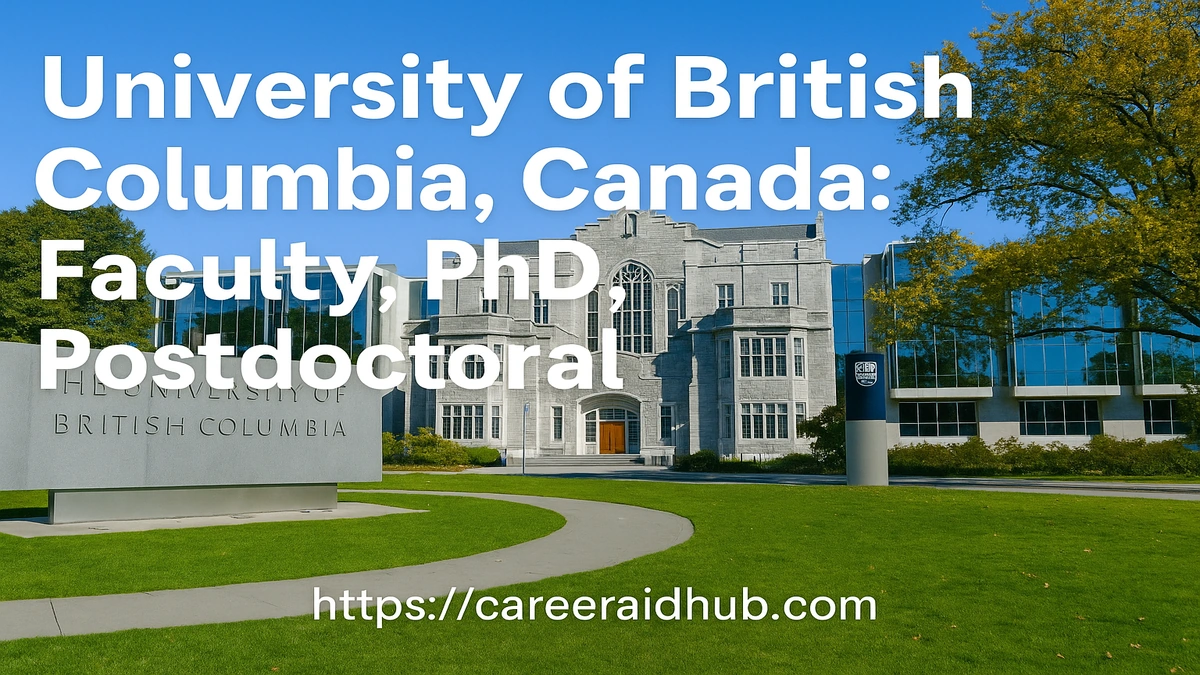
University of British Columbia vacancies for faculty, PhD, postdoctoral and student roles: a complete opportunity guide
Finding the right opening at a top university often feels harder than doing the research itself. That is why this guide focuses on University of British Columbia vacancies for faculty, PhD, postdoctoral and student roles in one place. UBC hires across Vancouver and Okanagan campuses, and it publishes opportunities through clear official channels. However, each role type follows a different pathway, timeline, and selection logic.
In this article, you will learn where to search, how to interpret postings, what documents to prepare, and how to apply with fewer mistakes. You will also get practical tips tailored for Indian applicants and international candidates who want Canada-focused academic pathways.
Why UBC opportunities matter for global applicants
UBC sits among Canada’s leading research universities and attracts strong international talent. Therefore, UBC roles can add credibility to your academic CV and improve long-term mobility. In addition, UBC offers structured pathways across career stages, from campus jobs and graduate programs to postdoctoral appointments and faculty recruitment.
Moreover, UBC’s hiring and admissions ecosystems are transparent when you use the correct portals. That transparency reduces confusion. It also helps you avoid unreliable third-party listings that sometimes recycle old posts.
Finally, UBC opportunities often connect to high-quality research environments, modern facilities, and interdisciplinary teams. As a result, applicants who plan well can convert “just browsing” into
What types of vacancies does UBC offer?
UBC opportunities broadly fall into four buckets. Each bucket uses different systems, so you should choose your approach early.
Faculty vacancies
Faculty roles include tenure-track, term, research-stream, and academic leadership appointments. UBC typically lists these openings through its official faculty careers channel.
PhD and graduate admissions
PhD opportunities usually appear as graduate program admissions, supervisor-led recruitment, or funded projects within labs. Therefore, you should search programs first, then align with research groups.
Postdoctoral and research fellow roles
Postdoc roles at UBC can be advertised through faculty careers postings, department pages, or supervisor networks. In addition, UBC has a dedicated postdoctoral office that explains how these roles work.
Student jobs and campus work opportunities
UBC students can access paid roles through on-campus jobs and structured programs such as Work Learn. These positions are valuable because they build Canadian experience and references.
Who this guide is for
This article helps four major audiences, although your strategy should differ by category.
For Indian students and international applicants
If you plan to move to Canada, you should focus on two priorities: program fit and document readiness. In addition,
For early-career researchers
If you recently completed a PhD, postdoc opportunities and research fellow roles can offer a bridge to faculty-track profiles. Therefore, your application must show both research independence and collaboration readiness.
For experienced academics
If you target faculty roles, you should prepare a research statement, teaching dossier, and evidence of impact. Moreover, you should match your expertise to the unit’s priorities rather than applying broadly.
For current UBC students
If you already study at UBC, campus jobs and Work Learn roles can strengthen your employability. In addition, these roles often teach professional skills that your coursework cannot.
Where to find official UBC vacancies
The fastest way to avoid outdated information is to rely on UBC’s official channels. Use these paths based on your goal:
Faculty and staff job postings
Start with UBC Human Resources careers pages. From there, you can filter faculty, staff, temporary, and student postings. This route reduces the risk of duplicate or expired listings.
Faculty careers portal
For professor, lecturer, and academic appointments, use the faculty careers listings, which typically point you to the current postings system. If you see multiple sites, treat the HR faculty careers page as the reliable starting point.
Postdoctoral opportunities pathways
Use two
Graduate programs and PhD admissions
For PhD and master’s pathways, use UBC Graduate and Postdoctoral Studies pages. Start from program listings, then open program-specific requirements. After that, identify supervisors, labs, and current research themes.
Student jobs and Work Learn
If you want student employment, explore UBC’s on-campus jobs guidance and Work Learn program pages. Then, apply through the careers platform used by UBC students for these roles.
Below is a clean, SEO-friendly section you can directly insert into your article under a suitable H2 or H3 heading.
Disciplines and Departments at the University of British Columbia
The University of British Columbia offers vacancies across a wide and interdisciplinary academic spectrum. Openings vary by campus (Vancouver and Okanagan), funding availability, and departmental priorities. However, the following disciplines and departments regularly feature faculty, PhD, postdoctoral, and student opportunities.
Science, Engineering, and Technology
-
-
Computer Science
-
Electrical and Computer Engineering
-
Mechanical Engineering
-
Civil Engineering
-
Chemical and Biological Engineering
-
Materials Engineering
-
Biomedical Engineering
-
Data Science and Artificial Intelligence
-
Mathematics and Applied Mathematics
-
Statistics
-
Physics and Astronomy
-
Chemistry
-
Earth, Ocean and Atmospheric Sciences
-
Environmental Sciences
-
Life Sciences, Health, and Medicine
-
-
Life Sciences
-
Molecular Biology and Biochemistry
-
Microbiology and Immunology
-
Biochemistry
-
Neuroscience
-
Pharmacology
-
Population and Public Health
-
Experimental Medicine
-
Medical Genetics
-
Pathology and Laboratory Medicine
-
Nursing
-
Occupational Science and Therapy
-
Sustainability, Climate, and Natural Resources
-
-
Forestry and Forest Sciences
-
Land and Food Systems
-
Climate and Environmental Change
-
Sustainable Energy Systems
-
Water Resources and Hydrology
-
Biodiversity and Conservation Biology
-
Resource Management and Policy
-
Social Sciences
-
-
Economics
-
Political Science
-
Sociology
-
Psychology
-
Anthropology
-
Geography
-
International Relations
-
Development Studies
-
Public Policy and Administration
-
Arts, Humanities, and Education
-
-
English and Literary Studies
-
History
-
Philosophy
-
Languages and Linguistics
-
Cultural Studies
-
Art History and Visual Arts
-
Music and Theatre
-
Creative Writing
-
Education and Curriculum Studies
-
Educational Psychology
-
Business, Law, and Professional Schools
-
-
Sauder School of Business (Management, Finance, Marketing, Operations)
-
Accounting and Business Analytics
-
Strategy and Entrepreneurship
-
Law
-
Public Policy and Governance
-
Urban Planning and Regional Development
-
Interdisciplinary and Emerging Areas
-
-
Artificial Intelligence and Society
-
Digital Humanities
-
Health Informatics
-
Computational Biology
-
Climate Policy and Energy Transitions
-
Indigenous Studies
-
Gender, Race, and Social Justice Studies
-
Step-by-step: how to apply across faculty, PhD, postdoc, and student roles
Different roles require different application patterns. Therefore, use the right steps for your target category.
Step 1: Define your role category and campus
First, decide whether you target Vancouver, Okanagan, or both. Secondly, choose one primary role type: faculty, PhD, postdoc, or student employment. This focus improves your match and reduces generic applications.
Step 2: Build a role-specific document pack
A single CV rarely works across categories. Instead, prepare role-specific documents:
-
-
Faculty: CV, cover letter, research statement, teaching dossier, diversity/EDI statement (when requested)
-
PhD: academic CV, statement of purpose, research interests, transcripts, references, language scores (if required)
-
Postdoc: research CV, focused cover letter, 1–2 page research plan, publications, references
-
Student jobs: short resume, brief cover letter, availability, relevant campus experience
-
Moreover, keep file naming consistent. Hiring teams notice detail.
Step 3: Mirror the language of the posting without copying
Use the same competency terms that appear in the posting, such as “teaching,” “research program,” “interdisciplinary,” or “laboratory management.” However, write in your own words and support each claim with evidence.
Step 4: Apply early and track deadlines
Many UBC opportunities close when they fill the shortlisting pool. Therefore, applying early improves visibility. In addition, build a simple tracking sheet with role title, portal link, documents used, and follow-up date.
Step 5: Prepare for shortlisting and interviews
Shortlisted candidates often face structured interviews. For academic roles, expect questions about teaching philosophy, research direction, collaboration plans, and funding strategy. For student jobs, expect availability and role-fit questions.
Expert tips, common mistakes, and practical advice
Tip 1: Use a “two-layer” search strategy
Start broad at the official portal, then go narrow at the department or lab level. This approach works well at UBC because many groups post project-specific information on their unit pages.
Tip 2: Show outcomes, not only responsibilities
Instead of “worked on machine learning models,” write “built a model that improved accuracy by X% on Y dataset.” Similarly, for teaching, mention course types, student level, and your role.
Tip 3: Avoid mass applications across unrelated fields
UBC shortlisting teams can detect generic applications quickly. Therefore, apply to fewer roles with stronger customization. Quality almost always beats volume in academic hiring.
Tip 4: For Indian applicants, plan for documentation early
International applications often require transcripts, degree certificates, and standardized documents. Therefore, request official documents early and keep certified copies ready.
Common mistakes to avoid
-
-
Using the wrong portal for the role type
-
Submitting a publication list without links or DOIs
-
Writing a research plan that does not match the department
-
Missing required statements or reference formats
-
Applying late and assuming rolling review will still consider you
-
Conclusion
UBC offers a wide spectrum of opportunities, from student employment and graduate study to postdoctoral roles and faculty recruitment. However, success depends on using the correct official portal and tailoring your documents to the role category. Moreover, early preparation improves outcomes because academic applications require multiple supporting documents and strong references. Use the official UBC careers and graduate studies pages as your foundation, then go deeper into departments and research groups for the best fit. Finally, bookmark this guide and build a weekly routine for searching and applying consistently.
| Feature | Details |
|---|---|
| Name | Faculty, PhD, Postdoctoral, and Student Opportunities – The University of British Columbia (UBC) |
| Country | Canada (Vancouver and Okanagan, British Columbia) |
| Funded By | UBC, Grants, departments, Supervisors |
| Duration | Varies by role (faculty contracts, PhD timelines, postdoc appointments, student jobs) |
| Study Mode | Full-time / Part-time / Hybrid (depends on role or program) |
| Eligibility | Varies by category (faculty qualifications, graduate admission requirements, postdoc criteria, student status for campus jobs) |
| Support | Varies (salary for jobs; stipends/funding packages for graduate roles; grant-funded postdoc salaries) |
| Fields | Broad, across most academic disciplines and professional fields |
| Deadline | Varies / Not announced centrally (depends on posting or program) |
| Website | Opportunities – The University of British Columbia |
Frequently Asked Questions
Use UBC’s official HR careers pages for jobs and UBC Graduate and Postdoctoral Studies pages for PhD admissions. Then, use unit pages for specific research groups.
Align your research plan with the lab’s direction, show strong publications, and highlight independent contributions. In addition, secure references who can speak to research ownership.
No. Many PhD pathways run through graduate program admissions and supervisor recruitment. Therefore, start with the program list and contact relevant supervisors professionally.
UBC guidance often indicates seasonal hiring patterns. Therefore, check on-campus jobs and Work Learn postings early and apply soon after they open.
Use third-party boards only to discover keywords. However, always confirm details and apply through UBC’s official portals to avoid outdated listings.
Many faculty roles request teaching-related documents. Therefore, prepare a teaching statement, sample syllabi, and evidence of teaching effectiveness if you have it.
Create a simple tracker with role link, deadline, documents, and submission status. In addition, set reminders one week before each key date.
Premium Mentorship for a Stronger Application
- Premium Mentorship: personalised 1:1 guidance for this and similar opportunities
- In-depth review of your CV, academic profile, and key statements
- Aligned with international selection criteria so your profile matches what panels expect
- Stronger, more compelling narrative for highly competitive calls
- Step-by-step support from opportunity mapping to final submission (fee-based)