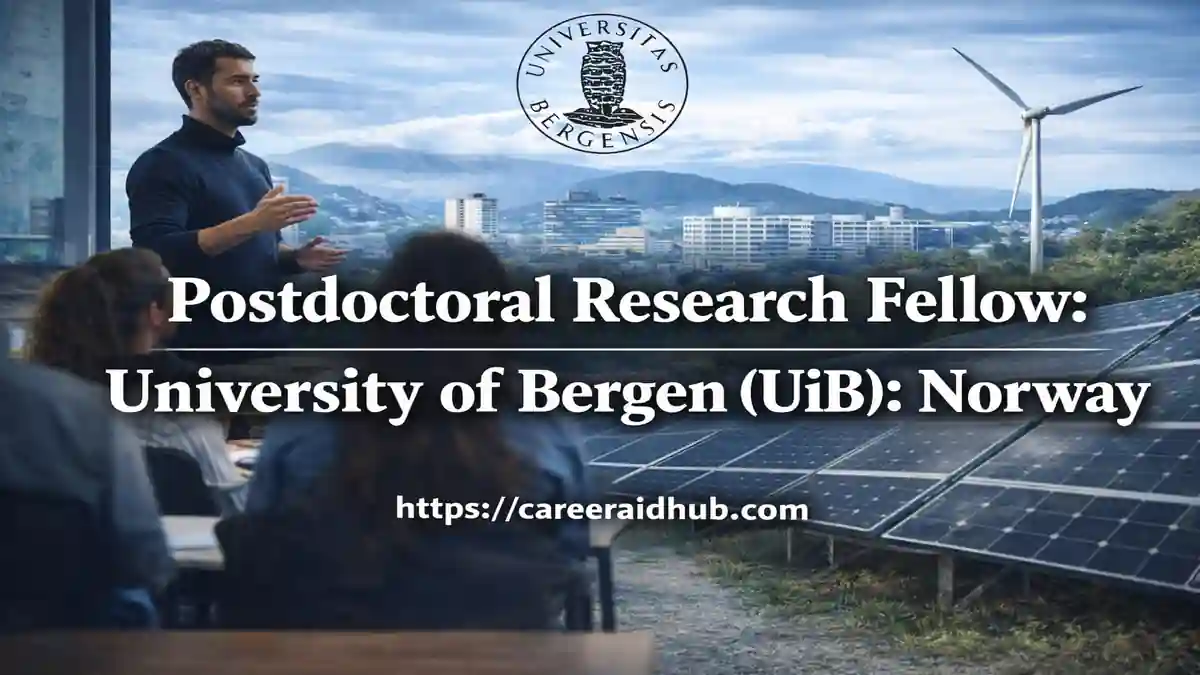
Postdoctoral Research Fellow – Centre for Climate and Energy Transformation, University of Bergen
The Postdoctoral Research Fellow Centre for Climate and Energy Transformation UiB position is one of the most attractive options in Europe for social scientists and interdisciplinary researchers working on climate and energy transitions. Hosted at the University of Bergen (UiB) in Norway, this postdoc is based at the Centre for Climate and Energy Transformation (CET), an interdisciplinary hub dedicated to producing actionable knowledge on rapid, just and deep societal transformation in response to the climate crisis.
In this guide, you will learn what CET is, how the postdoctoral position is structured, who should consider applying, and how to craft a competitive application. While the specific advertisement used here has already closed, future calls at CET typically follow a similar pattern, so this overview will help you prepare in advance.
Overview of the CET Postdoctoral Research Fellow Position
The Centre for Climate and Energy Transformation is located within UiB’s Faculty of Social Sciences and works closely with researchers from multiple disciplines, including geography, sociology, political science, economics and environmental studies.
In its most recent advertisement, CET announced a three-year, full-time postdoctoral research fellow position hosted by the Department of Geography. The goal of the position is to qualify the appointee for top academic roles while
The position is thematically open within CET’s research areas. Instead of assigning a narrow pre-defined project, CET invites the postdoc to propose a research plan aligned with topics such as:
-
-
Urban climate and energy transformations
-
Governance of low-carbon transitions
-
Justice, democracy and public participation in energy policy
-
Social dimensions of climate mitigation and adaptation
-
This flexibility makes the role highly attractive for ambitious researchers who want to shape their own agenda within a leading climate and energy transformation centre.
Why a Postdoctoral Research Fellow Role at CET Matters
A postdoc at CET offers much more than a salary and an academic title. It is a strategic stepping-stone toward an international research career in climate and energy transformation.
Firstly, the centre’s mission is to generate “actionable knowledge” that informs policy and practice on deep, rapid and sustainable transitions. Therefore, your work is likely to engage real-world stakeholders such as municipalities, ministries, civil-society organisations and businesses.
Secondly, CET is strongly interdisciplinary. You interact daily with researchers from
Thirdly, the position is explicitly designed to qualify you for top academic posts. UiB emphasises that the primary objective of the postdoctoral research fellow category is capacity building for future professorial and research-intensive careers.
Eligibility: Who Should Apply?
Academic Background
Recent CET calls specify that applicants must hold a PhD (or equivalent) in a social science or another discipline relevant to CET’s research areas. Candidates who have submitted their doctoral thesis for assessment before the application deadline may also apply, provided the degree is awarded by the time the position starts.
Relevant disciplinary backgrounds include, for example:
-
-
Human geography
-
Sociology or social anthropology
-
Political science or public policy
-
Environmental studies and sustainability science
-
Interdisciplinary climate or energy studies
-
Research Profile and Skills
To succeed, you should demonstrate:
-
-
A documented track record
of publications and research development within the thematic area you propose. -
Ability to work independently and in a structured manner, while also collaborating effectively within teams.
-
Strong written and spoken English skills; knowledge of a Scandinavian language is helpful but not always mandatory.
-
Potential candidates may be invited to CET for an interview and may be asked to deliver a trial lecture on a given topic, which tests both teaching and communication skills.
For International Applicants
International researchers are welcome to apply, as UiB positions are advertised globally through Jobbnorge and EURAXESS. However, you must meet formal PhD requirements and be able to relocate to Bergen for the full contract period. UiB emphasises diversity and actively encourages applications from candidates with varied backgrounds and from under-represented groups.
Key Features, Duration and Funding
The postdoctoral research fellow position at CET has several distinctive features:
-
-
Duration: Fixed-term for three years, with no possibility of holding more than one postdoc term at the same institution.
-
Scope: Full-time appointment, normally 100% of a standard working week.
-
Workplace: CET offices at the University of Bergen, with integration into the Department of Geography and the wider Faculty of Social Sciences.
-
Salary and Benefits
UiB offers a competitive Norwegian public-sector package. The recent CET postdoc announcement specified:
-
-
Gross annual salary: postdoctoral research fellow code 1352, pay grade 63, which corresponds to approximately NOK 615,700 per year, with higher grades possible for highly qualified candidates.
-
Pension and welfare: enrolment in the Norwegian Public Service Pension Fund and access to good welfare benefits.
-
In addition, you benefit from Norway’s strong social security system, work-life balance policies and a vibrant research environment in Bergen, a city known for its coastal landscapes and active cultural scene.
How to Apply: Step-by-Step Guide
Although each call may differ slightly, recent CET advertisements use the Jobbnorge recruitment portal. A typical application process includes the following steps:
-
-
Read the official advertisement carefully
Visit UiB’s “Vacant positions” page and open the listing for the Postdoctoral Research Fellow position at CET. Review eligibility conditions, expectations and deadline. -
Develop a strong research statement
CET expects a 4–5-page research statement. You should outline your proposed project, research questions, theoretical framework, methods and how your work aligns with CET’s research profile and strategy. -
Prepare your CV and list of publications
Update your academic CV with your education, positions, grants, conference presentations and peer-reviewed publications. Highlight outputs most relevant to climate and energy transformation. -
Collect documentation
Upload transcripts and diplomas, confirmation of the submitted or awarded PhD thesis, and relevant certificates or reference letters. -
Provide references
You must normally list two referees, including your main PhD supervisor. Make sure you inform them early so they can respond promptly if the committee contacts them. -
Submit through Jobbnorge
All documents must be uploaded via the Jobbnorge portal in English or a Scandinavian language. Incomplete applications are rarely considered, so double-check each section before submission. -
Prepare for possible interview and trial lecture
Shortlisted candidates may be invited to Bergen or to an online interview. You may also be asked to hold a lecture for assessment of your teaching skills.
-
Tips, Common Mistakes and Expert Advice
Applying for the Postdoctoral Research Fellow Centre for Climate and Energy Transformation UiB position is competitive. The following suggestions can strengthen your profile:
-
-
Align tightly with CET’s strategy
Read the CET website and its strategy documents to understand current projects and thematic priorities. Then, explicitly explain how your proposed work contributes to these priorities. -
Show a balance of independence and collaboration
CET values researchers who build their own agenda but also engage with ongoing projects. Mention potential collaborations with specific CET researchers and external partners. -
Avoid vague research proposals
A common mistake is submitting a statement with broad goals but little methodological detail. Instead, define clear research questions, case studies, data sources and analytic approaches. -
Highlight societal relevance
Because CET focuses on actionable knowledge, emphasise how your research can inform policy, governance or citizen engagement in climate and energy transitions. -
Plan realistically for a three-year timeline
Break your project into phases—data collection, analysis, writing and dissemination. A realistic work plan shows that you understand the constraints of a fixed-term postdoc.
-
Conclusion: Is This Postdoc the Right Next Step?
The Postdoctoral Research Fellow Centre for Climate and Energy Transformation UiB position is ideal for researchers who want to combine rigorous academic work with real-world climate and energy challenges. It offers a three-year window to develop an independent research profile, collaborate across disciplines and contribute to policy-relevant knowledge on sustainability transitions.
Because the competition is strong, you should invest significant time in crafting a focused, well-argued research statement and in demonstrating your publication record and collaborative skills. In addition, you should keep a close eye on UiB’s recruitment pages, as application windows can be relatively short.
If you are ready to deepen your expertise on climate and energy transformation, and you are eager to live and work in a leading Norwegian university city, this postdoctoral path is worth serious consideration. Start by reviewing the official guidelines, mapping how your work fits CET’s agenda, and planning your application timeline well ahead of the next call.
Summary Table
| Feature | Details |
|---|---|
| Program | Postdoctoral Research Fellow at the Centre for Climate and Energy Transformation (CET), University of Bergen |
| Host | Norway |
| Funded | University of Bergen (UiB) via the Centre for Climate and Energy Transformation and associated research projects |
| Duration | 3 years, fixed-term |
| Mode | Full-time, on-campus research position |
| Eligibility | PhD in a social science or closely related field, strong publication record, ability to work independently and collaboratively, high level of English |
| Support | Gross annual salary around NOK 615,700 (pay grade 63) with pension fund enrolment and welfare benefits; final package per official advert |
| Fields | Climate and energy transformation, urban and regional studies, governance of transitions, sustainability and related social science topics |
| Deadline | Varies by call; recent advertisement had a deadline in mid-January (see current UiB vacancy listing for exact date) |
| Website | Vacant Positions UIB |
Frequently Asked Questions
No. The position is open to qualified international applicants who meet UiB and Norwegian employment requirements.
A PhD in social sciences is common, but applicants from other relevant fields, such as environmental studies or interdisciplinary energy research, may also be competitive.
The standard contract length is three years, with no option for a second postdoc period at the same institution.
English is the main working language in many research groups. However, learning some Norwegian can help you integrate and may benefit certain projects.
The main focus is research, but you may be asked to contribute to teaching or supervision in related programmes, depending on departmental needs.
Calls depend on project funding and institutional plans. You should monitor UiB’s vacant positions page and CET’s website for new advertisements.
Yes, provided you have submitted your thesis before the application deadline and the degree is formally awarded before the contract starts.
Premium Mentorship for a Stronger Application
- Premium Mentorship: personalised 1:1 guidance for this and similar opportunities
- In-depth review of your CV, academic profile, and key statements
- Aligned with international selection criteria so your profile matches what panels expect
- Stronger, more compelling narrative for highly competitive calls
- Step-by-step support from opportunity mapping to final submission (fee-based)