Kuwait University College of Sciences Faculty Recruitment for International Applicants
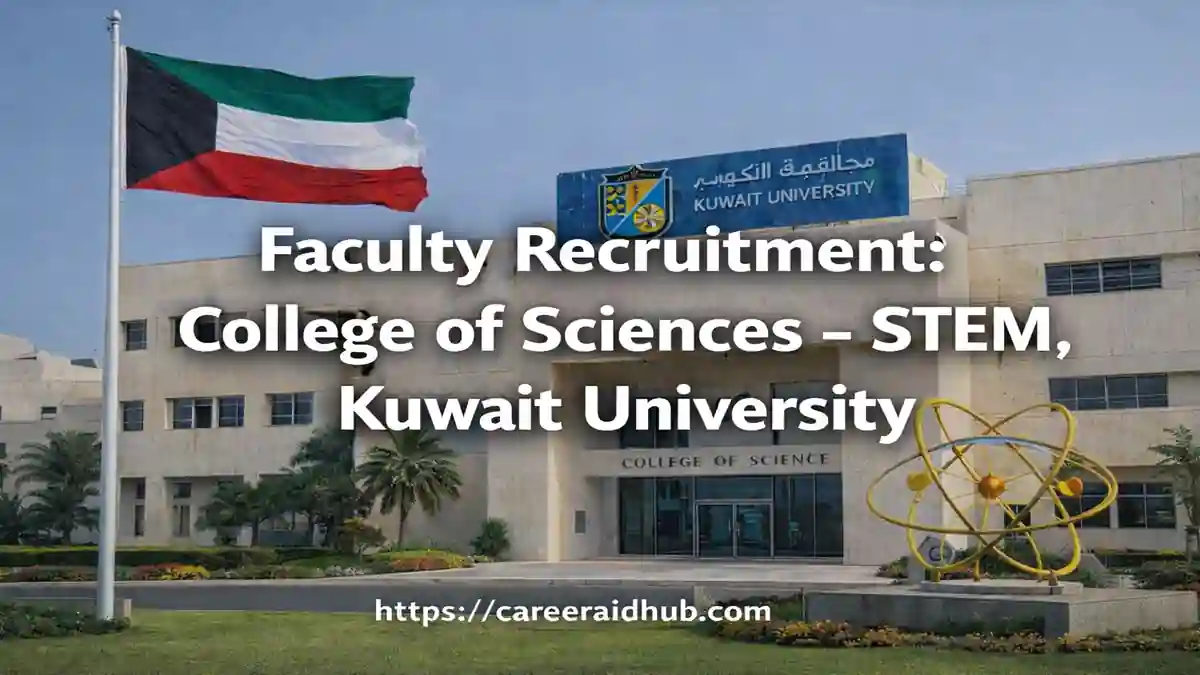
Kuwait University regularly opens faculty vacancies through its official academic recruitment system, including opportunities linked to the College of Sciences (STEM). This guide explains how Faculty Recruitment: College of Sciences – STEM, Kuwait University works, what international applicants should prepare, and how to apply through the official portal. In addition, you will learn practical, hiring-committee aligned strategies to strengthen your academic profile and avoid common errors that delay shortlisting.
Because vacancy lists and deadlines change by department and rank, treat the official recruitment portal as the only source of “current openings” and submission windows.
Why Kuwait University College of Sciences faculty recruitment matters
For international STEM academics, Kuwait University can be an attractive destination for three reasons. First, it is a national public university with a broad teaching and research mandate, so roles often combine undergraduate teaching, graduate supervision, and research output expectations.
Second, the College of Science spans multiple departments across core STEM areas. That breadth increases the probability of discipline-aligned openings, especially in high-demand teaching and research fields such as mathematics, microbiology, and related areas.)
Third, the application
About the College of Sciences (STEM) at Kuwait University
Kuwait University’s College of Science is positioned as a foundational STEM college serving national scientific and educational needs. The official College of Science profile highlights its academic departments and lab infrastructure, describing a large teaching and research laboratory base and a multi-department structure.
From a recruitment perspective, that matters because it suggests two expectations during screening:
-
- Evidence of discipline strength (publications, projects, teaching competence).
- Evidence of lab, field, or computational capability aligned to departmental needs.
In other words, applicants should show depth in one area while also demonstrating collaboration readiness across interdisciplinary STEM programs.
Eligibility and who these roles are for
Faculty recruitment at Kuwait University typically targets candidates suitable for academic ranks such as Assistant Professor, Associate Professor, and Professor, depending on the vacancy. Openings are posted by college and department in the recruitment listings.
For international applicants
International candidates should assume the committee will look for four basics first:
-
- A terminal degree (usually PhD) in a closely related STEM field.
- Ccredible publicationrecord that matches the rank being applied for.
- Evidence of teaching effectiveness, including course coverage and student outcomes.
- A research plan that fits departmental priorities and local context.
Importantly, Kuwait University’s official recruitment page states that applicants must meet requirements at the time of application, and it also notes that meeting qualifications does not guarantee hiring.
For early-career STEM academics
If you are early-career, focus on roles that emphasize teaching and research potential rather than only senior leadership. Build a compact, evidence-based application package with:
-
- Academic CV.
- Targeted research statement with a realistic 2–3 year plan.
- A teaching philosophy with measurable examples.
That combination often performs better than a generic “one CV for all jobs” approach.
Key highlights and what to expect from the recruitment process
Kuwait University posts opportunities through its VPAA faculty recruitment pathway, and applicants are directed to apply online through the recruitment system. The official VPAA page provides links to apply and to create an account.
While specific vacancy conditions vary, most faculty recruitments typically include:
-
- Department-level screening of minimum requirements.
- Shortlisting based on research fit, teaching capacity, and rank alignment.
- Interviews, and in many cases a research seminar or teaching demonstration.
- Reference checks and credential verification.
Therefore, your application should be designed to support all four steps, not only the first screening.
Step-by-step: How to apply through the official portal
Use the official recruitment portal workflow, because it is the channel Kuwait University itself points to for active openings.
Step 1: Find an active College of Sciences vacancy
Start at the official “Open Faculty Positions” listing page and filter for the College of Sciences and your discipline. Vacancy titles often include department names and rank options.
If the English listing is temporarily slow to load, you may see an Arabic version indexed as well, but always cross-check details on the official recruitment system before submitting.
Step 2: Create an account and prepare your profile
The VPAA recruitment page instructs applicants to apply via the recruitment system and to create an account if they do not already have one.
As you complete your profile, keep entries consistent with your CV. Small mismatches (dates, titles, journal names) can create delays in committee verification.
Step 3: Upload documents in committee-friendly order
Even when portals accept uploads in any sequence, committees review applications in a predictable order. Put the most decision-critical documents first:
-
- Academic CV (rank-aligned, withcomplete publication details).
- Cover letter tailored to the department.
- Research statement (problem, methods, outcomes, and a 2–3 year plan).
- Teaching statement (courses, pedagogy, assessment examples).
- Copies of degrees and transcripts (as requested).
- References and contact details (ensure they are reachable).
- Academic CV (rank-aligned, with
Moreover, keep file names professional and searchable, such as: Surname_Firstname_CV.pdf.
Step 4: Submit early and document your submission
Many applicants submit close to the deadline and then discover a missing upload or portal timeout. Submitting early gives you time to correct issues without losing the vacancy window.
As a practical safeguard, save a PDF copy of your final application summary and record your submission confirmation details.
Step 5: Prepare for interview and demonstration
If shortlisted, prepare a concise research talk that aligns to the department and the College of Science environment. Use one “core project” and two “supporting projects” that show continuity.
In addition, prepare a sample lecture outline. Committees often judge clarity, structure, and student engagement strategies, not only technical depth.
Expert tips, common mistakes, and practical advice
Tip 1: Match your application to the rank
Rank mismatch is a quiet rejection reason. If you apply for Associate Professor without evidence of sustained output, leadership, or postdoctoral maturity, the committee may not shortlist you even if you are strong overall.
Instead, target the rank where your record looks “obviously qualified,” and then negotiate growth within the institution.
Tip 2: Show fit to local research realities
A common mistake is proposing a research plan that requires equipment or funding that is not realistic in the first year. A stronger approach is phased planning:
-
- Phase 1: publishable work using existing methods and collaborations.
- Phase 2: build lab capacity and student pipeline.
- Phase 3: expand into funded projects.
This structure signals execution ability.
Tip 3: Avoid “publication dumping”
Long publication lists are helpful only when they are readable. Create an indexed section:
-
- Most relevant peer-reviewed papers (top 8–12).
- Full publication list.
- Grants and funded projects.
- Patents or applied outputs (if relevant).
As a result, the reviewer can quickly see impact and fit.
Tip 4: Do not ignore teaching evidence
International applicants sometimes underplay teaching, assuming research dominates STEM hiring. However, faculty roles often require heavy course delivery. Provide at least two proof points:
-
- Courses taught with level and class size.
- A short outcome metric (pass rates, student feedback summary, curriculum innovation).
Tip 5: Treat “requirements” as compliance, not persuasion
The official page is clear that meeting requirements does not guarantee hiring. Therefore, your goal is to exceed requirements with evidence of fit, execution, and collegial collaboration.
Summary Table
|
Feature |
Details |
|
Program Name |
Faculty Recruitment: College of Sciences (STEM), Kuwait University |
|
Host Country |
|
|
Funded By |
Kuwait University (public university) |
|
Duration |
Not specified on official website (varies by appointment/contract) |
|
Study Mode |
Full-time academic employment (not a study program) |
|
Eligibility |
Varies by vacancy and rank; applicants must meet requirements at time of application |
|
Financial Support |
Salary and benefits not specified on the official listing page |
|
Fields of Study |
STEM disciplines within the College of Science (department-based) |
|
Deadline |
Varies by vacancy; check the official vacancy listings (some postings show 31/01/2026) |
|
Official Website |
Click here |
Conclusion
Faculty Recruitment: College of Sciences – STEM, Kuwait University can be a strong pathway for international academics seeking a structured, centralized hiring process in Kuwait. The most effective applicants treat the portal submission as only the first step. They also build a committee-friendly case for research fit, teaching readiness, and rank alignment. Finally, they submit early and keep documents consistent across the portal profile and uploaded files.
For the most accurate openings, eligibility details, and deadlines, use the official university application portal and vacancy listings. Also, prepare your documents in advance so you can respond quickly when a suitable position appears.
Frequently Asked Questions (FAQs)
Kuwait University directs applicants to the official VPAA faculty position page and the recruitment system listings for active vacancies.
Yes. The recruitment system is presented as the centralized route for faculty applications, including account creation and submission.
No. The official VPAA page states that meeting qualifications does not guarantee hiring.
Deadlines vary by vacancy. Some College of Sciences posts close on 31-Jan-2026, but always confirm on the official portal.
Committees typically prioritize a rank-aligned CV, a focused research plan, and credible teaching evidence. Strong references and clean document formatting also help.
Apply to the best-fit rank, present a realistic two-year research plan, and provide concrete teaching examples. In addition, tailor your cover letter to the department.
Premium Mentorship for a Stronger Application
- Premium Mentorship: personalised 1:1 guidance for this and similar opportunities
- In-depth review of your CV, academic profile, and key statements
- Aligned with international selection criteria so your profile matches what panels expect
- Stronger, more compelling narrative for highly competitive calls
- Step-by-step support from opportunity mapping to final submission (fee-based)