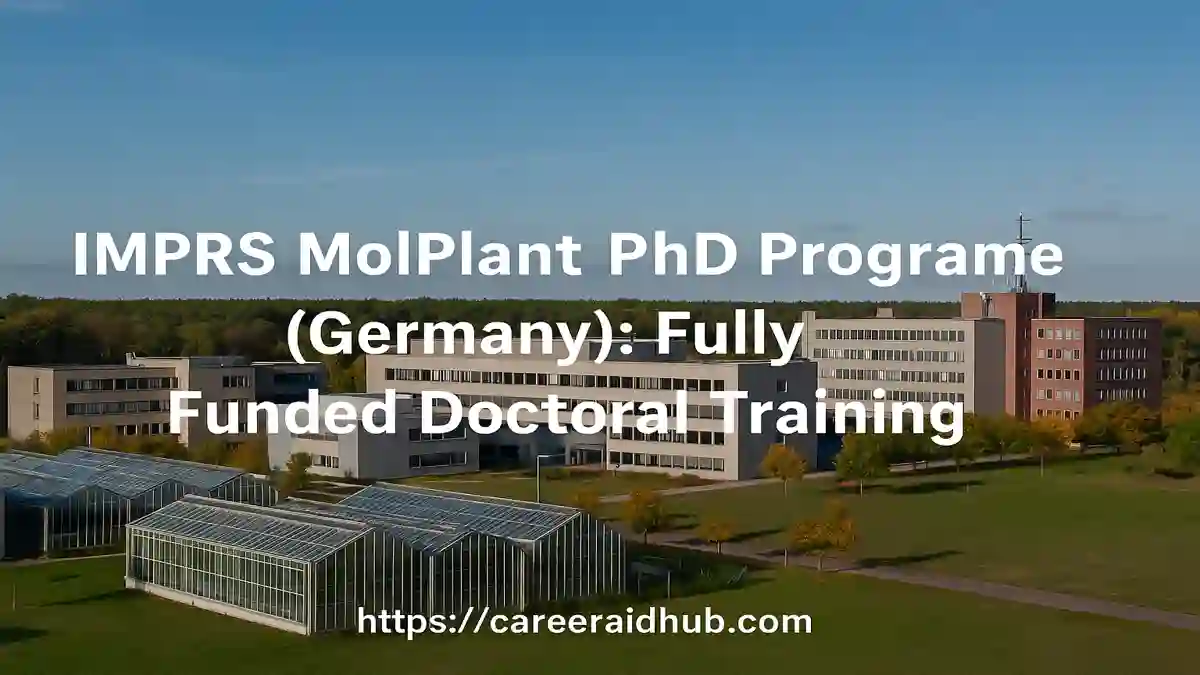
Introduction: What the IMPRS MolPlant PhD Programme Offers
The IMPRS MolPlant PhD programme in Germany is a fully funded international doctoral programme in molecular plant science, jointly run by the Max Planck Institute of Molecular Plant Physiology (MPI-MP) in Potsdam and the University of Potsdam. It brings together cutting-edge plant biology, quantitative methods, and a vibrant international research community.
In this article, you will learn how the programme is structured, who is eligible, what funding is offered, and how to prepare a competitive application. You will also find practical tips that go beyond the official brochure, so that you can decide whether this prestigious programme matches your academic goals.
Why the IMPRS MolPlant PhD Programme Matters
Plant science is central to food security, sustainable agriculture, and climate resilience. The IMPRS for Molecular Plant Science focuses on understanding how plants grow, adapt, and interact with their environment, using approaches that range from molecular genetics and epigenetics to metabolomics and systems biology.
Because the programme is embedded in the Potsdam Science Park, doctoral researchers work in a dense research ecosystem that includes several Max Planck Institutes, the University of Potsdam, Fraunhofer institutes, and start-ups. This environment encourages interdisciplinary projects and frequent scientific exchange.
Moreover, IMPRS MolPlant is a permanent graduate programme
Eligibility: Who Should Apply to IMPRS MolPlant?
Academic background
To join the IMPRS MolPlant PhD programme, you usually need a Master’s or equivalent degree in a discipline relevant to plant or life sciences, such as biology, biochemistry, molecular biology, biotechnology, bioinformatics, or related fields.
In exceptional cases, applicants with an excellent four-year Bachelor’s degree with a strong research component may also be considered. However, such candidates may be asked to take additional courses during their first year.
Language requirements
The working language of IMPRS MolPlant is English, both for research and for the structured training programme. Therefore, very good spoken and written English is essential. Applicants are encouraged to submit results from internationally recognised English tests such as TOEFL or IELTS. If no test is provided, the committee may conduct a telephone or online interview to evaluate your language skills.
German language skills are not required for the PhD, although learning German will make everyday life in Potsdam and
Personal profile
The programme looks for highly motivated graduates who are curious about fundamental questions in plant biology, comfortable with quantitative or computational methods, and willing to work in an international team. Previous experience with research projects, internships, or a Master’s thesis in a relevant lab will strengthen an application.
Key Features, Funding, and Training Structure
Fully funded PhD positions
One of the main advantages of the IMPRS MolPlant PhD programme is its funding model. PhD positions are fully funded for three years, with the possibility of extension. Doctoral researchers are usually employed on Max Planck or related institutional contracts that include:
-
- Net monthly income of roughly 1,900–2,100 EUR after taxes and social contributions.
- German public health insurance and social security coverage.
- Funding for conferences, workshops, and research visits from the host research group.
There are no tuition fees for doctoral candidates. Only an optional semester fee (approximately 325 EUR per semester) is charged by the University of Potsdam for enrolment as a student, which includes a nationwide public transport ticket (“Deutschland-Semesterticket”).
Joint degree and supervision
The programme is a joint initiative of MPI-MP and the University of
Each PhD candidate:
-
- Conducts research in one of the participating groups at MPI-MP, the University of Potsdam, or partner institutes.
- Is supported by a PhD advisory committee of 2–3 scientists who monitor progress and provide guidance.
- Presents results regularly in seminars and progress talks and attends courses on scientific and transferable skills.
This structured framework helps students develop independence while staying closely connected to supervisors and peers.
Research areas
IMPRS MolPlant covers a wide range of topics in modern plant science, including:
-
- Photosynthesis, central metabolism, and respiration.
- Plant development and organ formation.
- Epigenetics and epigenomics in plant reproduction.
- Plant–microbe and plant–fungus interactions, including arbuscular mycorrhiza.
- Plant responses to abiotic factors such as light, temperature, and nutrient availability.
- Plant antiviral immunity and viral replication.
- Systems biology, multi-omics data integration, and computational modelling.
Consequently, applicants with both experimental and computational interests can find suitable projects.
How to Apply: Step-by-Step Guide
The IMPRS MolPlant PhD programme runs an annual online application call, usually open between late December and January. For the current round, the published deadline is 10 January 2026, 23:59 CET, with positions starting in the second half of 2026. Always verify dates on the official website,
Step 1: Explore research groups
Firstly, read about the IMPRS faculty and their research groups on the programme website. Identify one or two groups whose work matches your interests and experience.
Step 2: Prepare documents
Typically, you will need:
-
- Curriculum vitae with academic background and research experience.
- Degree certificates and transcripts (or provisional documents if you are still studying).
- A motivation section explaining why you want to join specific groups.
- A short research essay outlining a possible project idea in your preferred group.
- Contact details of two academic referees who can provide recommendation letters.
- Evidence of English language proficiency, where available.
Step 3: Complete the online application
Next, fill in the online form through the IMPRS Application Portal. The application is entirely online; hard-copy submissions are not accepted.
The programme explicitly states that you must write the application yourself and may not use AI tools to generate the content of your motivation letter, CV, or research essay. You may only use such tools sparingly for minor language polishing and must declare this in the form.
Step 4: Selection and interviews
After an initial screening, shortlisted candidates are invited to a selection interview, usually held online or on site. The interview often includes a short presentation of your previous research and a discussion with potential supervisors. Final decisions are made afterwards, and successful candidates receive formal offers including funding details and expected start dates.
Expert Tips, Common Mistakes, and Application Advice
Firstly, start early. Because the application involves a research essay and tailored motivation for specific groups, drafting strong, well-researched text takes time.
Secondly, read several recent papers from your preferred groups. This preparation allows you to write an essay that goes beyond generic statements and shows that you understand their current projects and methods.
Thirdly, discuss your ideas with a trusted mentor. A supervisor or senior colleague can help you refine your essay and CV so they highlight your genuine strengths.
Common mistakes to avoid include:
-
- Very broad research interests with no clear link to any specific IMPRS group.
- Over-reliance on technical buzzwords without demonstrating conceptual understanding.
- Submitting incomplete forms or missing documents, which the selection committee cannot consider.
Finally, remember that the committee evaluates your potential, not just your publication record. A coherent story that connects your background, skills, and future goals can stand out even if your CV is still modest.
Conclusion: Is the IMPRS MolPlant PhD Programme Right for You?
The IMPRS MolPlant PhD programme in Germany offers an excellent opportunity for talented graduates who want to specialise in molecular plant science within a fully funded, structured, and international setting. With strong supervision, generous funding, and access to world-class facilities at the Max Planck Institute of Molecular Plant Physiology and the University of Potsdam, it provides a solid launchpad for a research career.
If you are passionate about understanding how plants function from molecules to whole organisms, and you are ready to commit several years to intensive research, this programme deserves serious consideration. Start by exploring the official IMPRS MolPlant pages, mapping your interests onto existing groups, and preparing your documents well in advance of the next deadline.
With thoughtful preparation and a clear research vision, you can present a compelling application and take a decisive step towards a future in plant science.
Summary Table
|
Feature |
Details |
|
Program Name |
International Max Planck Research School for Molecular Plant Science (IMPRS MolPlant) |
|
Host Country |
Germany (Potsdam, near Berlin) |
|
Funded By |
Max Planck Institute of Molecular Plant Physiology, University of Potsdam, and partner institutions |
|
Duration |
Typically 3 years, with possible extension |
|
Study Mode |
Full-time, on-site doctoral research |
|
Eligibility |
Master’s (or equivalent) in relevant life or plant sciences; excellent English; exceptional 4-year Bachelor’s considered in some cases |
|
Financial Support |
Fully funded PhD contract; net income roughly 1,900–2,100 EUR/month; health and social insurance; conference and research travel support |
|
Fields of Study |
Molecular plant physiology, metabolism, development, epigenetics, plant–microbe interactions, systems biology, and related areas |
|
Deadline |
Current call: 10/01/2026, 23:59 CET (future deadlines may vary) |
|
Official Website |
Click here |
References
Frequently Asked Questions (FAQs)
Yes. IMPRS MolPlant PhD positions are fully funded for three years, with possible extension. Doctoral researchers receive a work contract with health insurance, social security, and a net income of about 1,900–2,100 EUR per month.
No. The programme operates entirely in English. However, learning German is strongly recommended for daily life and better integration in Potsdam and Berlin.
Applicants should hold a relevant Master’s degree in plant or life sciences; exceptional candidates with a strong four-year Bachelor’s may also be considered with coursework.
Admission is selective; the committee reviews grades, research experience, recommendations, and your research essay. Strong academic records and clear alignment with research groups are essential.
You can’t choose a supervisor before admission, but you must indicate preferred groups, write a research essay, and receive final matching during or after interviews.
Doctoral studies at MPI-MP have no tuition fees; enrolling at the University of Potsdam requires only a semester fee, which includes a nationwide public transport pass.
The programme has no fixed start date; selected candidates usually begin between early summer and late autumn, depending on personal arrangements and visa processing timelines.
The latest deadlines, open calls, and application-portal details are always available on the official IMPRS MolPlant “IMPRS and PhD” and “IMPRS Application Call” pages.
Premium Mentorship for a Stronger Application
- Premium Mentorship: personalised 1:1 guidance for this and similar opportunities
- In-depth review of your CV, academic profile, and key statements
- Aligned with international selection criteria so your profile matches what panels expect
- Stronger, more compelling narrative for highly competitive calls
- Step-by-step support from opportunity mapping to final submission (fee-based)