The Collegium Helveticum Early-Career Fellowships at ETH Zürich are among the most attractive interdisciplinary postdoctoral opportunities in Europe. Designed for outstanding researchers and artists at the beginning of their independent careers, these ten-month residential fellowships in Zurich provide time, salary, and intellectual space to pursue bold, cross-disciplinary projects.
In this guide, you will find everything you need to know before applying: who the fellowships are for, what funding and support you receive, how the application process works, and practical tips to strengthen a competitive proposal. Whether you are an early-career academic or an art-school graduate working at the interface of disciplines, this fellowship can significantly accelerate your trajectory.
Why the Collegium Helveticum Early-Career Fellowships Matter
The Collegium Helveticum is a joint Institute for Advanced Study of ETH Zürich, the University of Zurich and the Zurich University of the Arts. It focuses on dialogue between sciences, humanities, social sciences, medicine, engineering and the arts, and hosts an international, interdisciplinary community of fellows every year.
The early-career fellowship program supports courageous projects that cross or even transgress disciplinary boundaries. Fellows are encouraged to move beyond their comfort zones, test new methods, and engage with other fields. The fellowship can also be used to further develop a well-conceived project into a competitive application for major grants such as ERC, SNSF Starting or Ambizione Grants.
justify;">For early-career researchers, this combination of protected time, high-level mentoring, and strategic grant-writing potential makes the program a powerful springboard toward long-term academic independence.
Eligibility: Who Should Apply?
Academic and Artistic Background
To be eligible, applicants must:
-
-
Hold a doctoral degree in an academic discipline, or
-
Hold a master’s degree from an art school in fields where doctoral degrees are not awarded.
The degree must have been obtained within eight years prior to the start of the fellowship. In addition, the program applies an academic age limit of five years, calculated from the date of your degree to the fellowship start date, with adjustments for part-time work, care responsibilities, or career breaks.
Early-Career Focus
These fellowships are aimed at scholars and artists who are:
-
-
At postdoctoral or equivalent level;
-
At a critical early stage of their career;
-
Ready to propose a mature project that goes beyond a PhD or master’s thesis.
Doctoral work itself cannot be funded, and the program is not intended for purely exploratory ideas that are not yet well defined.
International Applicants and Mobility
Applications are
welcome from
all countries. You do not need a current institutional affiliation, but you must be able to reside in the Zurich area during the fellowship and obtain the necessary work and residence permits for Switzerland. ETH Zürich’s human resources and services provide guidance on visa procedures.
Key Features, Funding and Academic Environment
Duration and Structure
-
-
Fellowship period: 10 months
-
Dates: 1 September 2026 – 30 June 2027 for the 2026–2027 cohort
-
Mode: Full-time, residential in Zurich
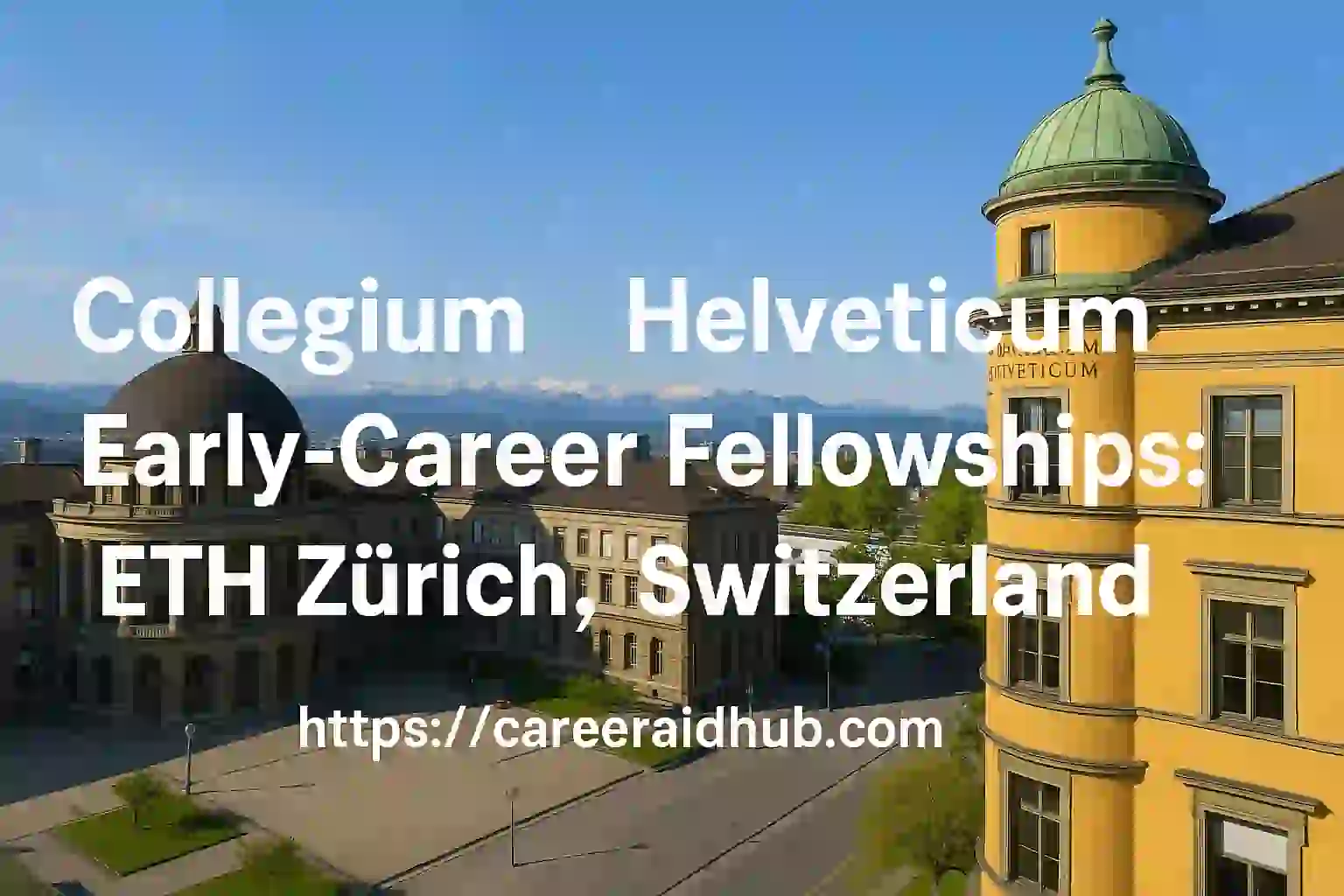
Fellows work primarily at the historic Semper Observatory, the home of the Collegium Helveticum, and are expected to be present on weekdays to participate in seminars, workshops and informal exchanges.
Employment and Salary
Early-career fellows are employed full-time as postdoctoral researchers at ETH Zürich for the duration of the fellowship. The salary follows ETH postdoctoral pay scales and is currently approximately CHF 75,000–85,000 for ten months, paid monthly. Fellows also receive:
-
-
Up to CHF 2,000 for research and travel costs;
-
Eligibility to apply for family allowance if they care for minor children or children in education;
-
Access to IT and library infrastructure, a desk, and a computer if needed;
-
Access to university sports and activity
programs.
Interdisciplinary Event and Budget
Each fellow organizes an interdisciplinary event linked to their project—such as a workshop, exhibition, panel discussion or performance. The Collegium provides up to CHF 10,000 to support the event, including travel, accommodation and production costs.
This requirement pushes fellows to build networks, test ideas in public formats, and connect with Zurich’s academic and artistic communities.
The Role of the Associate Fellow
A distinctive feature of the program is the requirement for an associate fellow—a faculty member at ETH Zürich, the University of Zurich or the Zurich University of the Arts who supports your project.
Your associate fellow:
-
-
Acts as an academic partner and local mentor;
-
May host you part-time in their research group or studio;
-
Helps you access needed infrastructure and networks;
-
Co-designs the overall trajectory of the project.
You must secure this support before submitting your application, although the full letter of support is only requested if you are long-listed. You cannot have been under the direct supervision of your associate fellow within the twelve months before the fellowship start.
Step-by-Step: How to Apply
justify;">1. Study the Program Materials
Start at the official early-career fellowship page and the dedicated FAQ section. Together, they describe eligibility, academic age calculation, project expectations, and application components in detail.
2. Shape a Mature, Interdisciplinary Project
The Collegium expects a well-defined project that is ready for intensive work and may be developed into a major grant proposal. Your project should:
-
-
Bridge disciplines or combine academic research and artistic practice;
-
Have clear aims, methods and outputs;
-
Show why the Collegium is the ideal environment to realize it.
3. Identify and Contact an Associate Fellow
Search the websites of ETH Zürich, the University of Zurich and the Zurich University of the Arts to find potential mentors. Reach out early with a concise project pitch and explain why collaboration could be mutually beneficial.
Once a faculty member agrees in principle, they can be listed as your associate fellow in the application portal.
4. Prepare Application Documents
Applications are submitted exclusively via the eResearch portal. You will need to prepare:
-
-
Structured text boxes (project abstract, fit with the Collegium, key contributions, personal statement, event description and budget);
-
A full project proposal using the official template;
-
CV with publication and output list;
-
Copy of highest degree certificate, or letter confirming degree completion by June 2026;
-
Passport or ID copy;
-
Supporting documents for academic-age reductions, if relevant.
5. Observe the Deadline and Timeline
For the 2026–2027 fellowship year, applications are due 12 February 2026, 17:00 CET. Online interviews for long-listed candidates are planned for 20–21 April 2026.
Tips, Common Mistakes and Expert Advice
Emphasise Interdisciplinarity with Substance
Avoid vague claims like “bridging science and society” without clear mechanisms. Instead, show concrete intersections: for example, a project that combines climate modelling, legal analysis and visual arts to explore climate justice. Explain how each discipline contributes and what new insight emerges from their interaction.
Show Why Zurich Is the Right Place
Use the “Why the Collegium?” section to connect your project to specific research groups, archives, laboratories or artistic scenes in Zurich. Mention how the associate fellow and local networks will help you achieve your aims, and how you will contribute in return.
Calibrate Scope for Ten Months
An over-ambitious project can signal inexperience. Design a scope that is challenging but realistic for ten months, leaving space for writing, networking and event organization. Where appropriate, indicate how the fellowship will position you for a subsequent ERC or SNSF proposal.
Avoid Administrative Pitfalls
Common mistakes include mis-calculating academic age, failing to upload required documents, or leaving event budgeting too vague. Use the factsheet, sample budget and checklist provided on the official site, and aim to submit at least several days before the deadline to avoid technical issues.
Conclusion
The Collegium Helveticum Early-Career Fellowships at ETH Zürich offer far more than a conventional postdoctoral job. They provide time, salary, mentorship and an inspiring environment to pursue ambitious interdisciplinary projects at the interface of science, society and the arts.
If you are an early-career researcher or artist with a mature idea, a clear sense of how different disciplines intersect in your work, and the willingness to relocate to Zurich for ten months, this program deserves serious consideration. Begin by reading the official guidelines, refining your project proposal and reaching out to potential associate fellows well in advance. Finally, mark the deadline, prepare your documents carefully and submit a polished application that shows both intellectual courage and realistic planning.
Summary Table
| Feature |
Details |
| Program |
Collegium Helveticum Early-Career Fellowship |
| Host |
Switzerland |
| Funded By |
Collegium Helveticum / ETH Zürich, University of Zurich, Zurich University of the Arts |
| Duration |
10 months (September – June) |
| Study Mode |
Full-time, residential in Zurich |
| Eligibility |
Doctoral degree or art-school master’s obtained within 8 years; academic age ≤5 years; early-career researchers or artists with interdisciplinary project |
| Support |
Full-time ETH Zürich postdoctoral salary (~CHF 75,000–85,000 for 10 months), up to CHF 2,000 research budget, up to CHF 10,000 event budget, possible family allowance |
| Fields |
All academic disciplines and artistic fields, with strong emphasis on interdisciplinary projects |
| Deadline |
12/02/2026, 17:00 CET (for 2026–2027 fellow year) |
| Official |
Collegium ETZ Fellowships/early-career-fellowship |
Frequently Asked Questions
Is knowledge of German required? No. The application and working language of the Collegium is English, so German is not mandatory, although basic German may help with daily life in Zurich.
Can I apply if I have not yet defended my PhD? Yes, you may apply if your supervisor or department chair confirms in writing that you will receive your degree by June of the fellowship start year. The final certificate must be available at least three months before the fellowship begins.
Do I need an institutional affiliation to apply? No. An active affiliation is not required at the time of application. However, you must secure an associate fellow at one of the three Zurich institutions.
Is the fellowship suitable for major fieldwork projects? Not usually. The fellowship is residential and expects regular presence in Zurich. One short research trip, typically not longer than two weeks, may be possible using your research budget.
Can I apply as part of a team? Yes. Small interdisciplinary teams of up to three people can submit a joint project. Each member needs an associate fellow and separate application inputs within the eResearch system.
Does the Collegium provide housing? No. The Collegium does not offer housing, but information about accommodation options is available via the joint housing office of ETH Zurich and the University of Zurich.
Premium Mentorship for a Stronger Application
- Premium Mentorship: personalised 1:1 guidance for this and similar opportunities
- In-depth review of your CV, academic profile, and key statements
- Aligned with international selection criteria so your profile matches what panels expect
- Stronger, more compelling narrative for highly competitive calls
- Step-by-step support from opportunity mapping to final submission (fee-based)
Subscribe Premium Mentorship