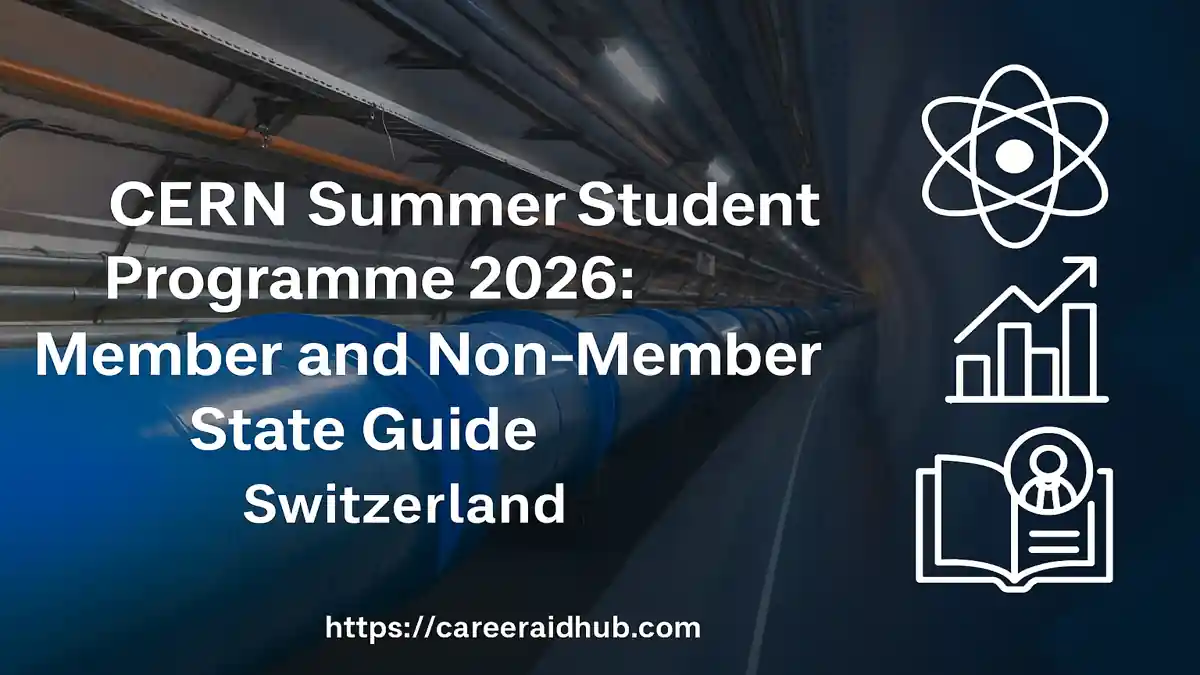
This guide explains what the 2026 Member and Non-Member State call offers, who can apply, how the funding works, and how to prepare a strong application. It is written for global students, including applicants from India and other Associate or Non-Member States who want a clear, practical overview before they apply.Over a short but intense stay at CERN in Geneva, you work on real projects, attend world-class lectures, and experience life inside the world’s leading particle physics laboratory.
The CERN Summer Student Programme 2026 is one of the most competitive summer research experiences in the world for Bachelor’s and Master’s students in physics, engineering, computer science, mathematics, and related fields.
Why the CERN Summer Student Programme 2026 Matters
Spending a summer at CERN is far more than a short internship. It is a chance to see how large-scale international science actually works.
Students selected for the CERN summer student 2026 member and non member state intake:
-
- Join experimental, engineering, IT or research teams and contribute to ongoing projects.
- Attend a dedicated lecture series in particle physics, engineering and computing, delivered by leading
experts.
- Take part in visits, workshops and discussions across CERN’s unique facilities.
For many participants, this programme becomes the first step toward a PhD, a long-term research career, or a role in cutting-edge industry. Moreover, the cohort is truly international; students come from both CERN Member and Non-Member States, which makes the summer a powerful networking and cultural experience.
Eligibility: Who Can Apply in 2026?
CERN defines clear criteria for the CERN summer student programme eligibility. Before you start your application, run through this checklist carefully.
Academic level and field of study
You must:
-
- Be a Bachelor’s or Master’s student, not a PhD candidate.
- Have completed at least six semesters (three academic years) of full-time university study by the start of summer 2026.
- Be enrolled in Physics, Engineering, Computer Science, Mathematics or a closely related discipline.
Students from interdisciplinary programmes can still apply if a strong part of their curriculum covers these core areas.
Nationality and student status
The 2026 call explicitly targets students from Member and Non-Member States, which means applicants from almost any country can apply, subject to their local eligibility for visas and student status.
justify;">In addition, you must:
-
- Remain enrolled as a full-time student at least until the start of your stay at CERN.
- Not have worked at CERN for more than three months in any other status.
- Not have participated in a previous CERN Summer Student Programme.
Language and personal profile
CERN looks for students who are:
-
- Comfortable working in English (French is welcome but not mandatory).
- Curious, motivated and eager to learn by doing.
- Able to work in diverse, international teams.
If you can demonstrate strong communication skills and enthusiasm for physics or technology, you already match a large part of the ideal profile.
Key Features, Funding and Programme Highlights
Understanding the structure of the programme helps you decide if this is the right fully funded summer research programme in Europe for you.
Duration, dates and location
-
- Location: CERN, Geneva, Switzerland.
- Ideal start date: 15 June 2026.
- Contract duration: around two months (between June and September, depending on your assignment).
- Mode: Full-time, fully onsite.
Financial support and practical benefits
The programme is not just prestigious; it is also well funded. For 2026, the CERN summer student stipend includes:
justify;">
93 CHF per calendar day, paid as a tax-free subsistence allowance.
Coverage by CERN’s health insurance scheme (deducted from the allowance) for most students.
Travel reimbursement for the trip to Geneva, depending on individual circumstances.
Help finding accommodation on the CERN site or nearby.
Alongside the allowance, you gain access to a rich lecture programme and, in many cases, IT-focused sessions organised with CERN openlab.
For many students, this means the programme behaves like a fully funded CERN summer internship for physics students and engineers, with only everyday living costs to manage.
Step-by-Step: How to Apply for the 2026 Intake
The official CERN summer student application deadline 2026 is 26 January 2026 at 23:59 (Geneva time).
Here is a simple roadmap to follow.
-
- Check you meet all eligibility criteria: Revisit the academic, nationality, and student status requirements described above. Make sure you will have completed six semesters by June 2026 and that you remain enrolled through the start of the programme.
-
- Prepare your documents: According to the official programme guidelines, you will need:
-
- A CV
in English or French.
- Any additional documents you consider relevant (such as proof of achievements or project summaries).
- An academic reference letter in English or French.
- An official transcript of your grades, also in English or French.
Plan enough time for your referee to write and submit the letter before the deadline.
- Complete the online application: Applications are handled through the CERN careers portal (see the official job page).
Visit the vacancy “CERN Summer Student Programme 2026 (Member and Non-Member State)”.
-
- Click “Apply now” and create or log into your account.
- Fill in personal details, education, language skills and motivation.
- Upload your CV, transcript and other documents.
- Attach the reference letter as instructed or ensure your referee has uploaded it.
Allow at least 15–20 minutes for the form and double-check every entry before submitting.
-
- Wait for the selection process: After the deadline, CERN supervisors review applications and shortlist candidates whose skills match available projects. Some areas may invite you to a brief online interview. If you are selected, you will receive an official offer with details on dates, travel arrangements and administrative steps.
Tips, Common Mistakes and Expert Advice
Many strong students apply each year, so you should treat this programme as highly competitive. Here are some practical suggestions to help your application stand out.
Highlight real technical experience
Do not just list courses. Instead, describe:
-
- Specific projects you have done in laboratories, hackathons, or course projects.
- Any experience with programming, data analysis, electronics, or simulations.
For instance, a student from India studying electronics engineering could briefly outline a project using FPGA boards or data acquisition systems. This shows that they can contribute to the kind of experimental or IT work CERN teams handle daily.
Tailor your motivation statement to CERN
Generic statements such as “I love physics” are not enough. Explain:
-
- Why CERN’s environment interests you more than a standard company internship.
- How working on a summer research opportunity at CERN Geneva fits into your long-term plans, whether that means a PhD or an engineering career.
Avoid common application errors
Several mistakes can quietly damage an otherwise strong profile:
-
- Missing or late reference letters – contact your referee early and send reminders.
- Unclear timelines – make sure your CV shows when each degree or semester took place.
- Ignoring the time zone – remember that the deadline uses Geneva time, which may differ from your local time.
- Overlooking English proficiency – proof of courses, exams or study in English can reassure selectors that you will cope with lectures and teamwork.
Think beyond acceptance
If you are selected, prepare to maximise the experience:
-
- Review basic particle physics and your own technical domain before arriving.
- Set realistic goals, such as preparing one conference-style poster or a small software tool.
- Network intentionally with supervisors and fellow students; these contacts can support future PhD or job applications.
Conclusion: Is CERN Summer Student 2026 Right for You?
The CERN Summer Student Programme 2026 offers an exceptional combination of hands-on research, structured teaching, financial support and international networking. If you are a Bachelor’s or Master’s student with solid grounding in physics, computing, engineering or mathematics, it can be a transformative step toward a research-oriented future.
Because the call welcomes both Member and Non-Member State applicants, motivated students from all regions—including India and other Associate Members—have a realistic chance if they present a strong, well-prepared application. Start early, refine your CV and motivation, secure a committed referee, and submit everything well before the January deadline.
To confirm every detail and begin your application, visit the official programme page and the general CERN Summer Student information site. Consider bookmarking those links, and share this guide with classmates who also dream of spending a summer at CERN.
Summary Table
|
Feature
|
Details
|
|
Program Name
|
CERN Summer Student Programme 2026 (Member and Non-Member State)
|
|
Host Country
|
Switzerland (CERN, Geneva)
|
|
Funded By
|
CERN, with additional support from external sponsors for some Non-Member State positions
|
|
Duration
|
Around 2 months during European summer 2026
|
|
Study Mode
|
Full-time, onsite at CERN
|
|
Eligibility
|
Bachelor’s or Master’s students in physics, engineering, computer science, mathematics or related fields; at least 6 semesters completed; enrolled at start; no prior CERN Summer Student stay; limited previous CERN employment
|
|
Financial Support
|
93 CHF/day tax-free allowance, health insurance coverage, travel reimbursement to Geneva, assistance with accommodation
|
|
Fields of Study
|
Physics, engineering, computer science, mathematics and related disciplines across many CERN departments
|
|
Deadline
|
26/01/2026 (23:59 Geneva time)
|
|
Official Website
|
Click here |
Frequently Asked Questions (FAQs)
Who can apply for the CERN Summer Student Programme 2026? Bachelor’s and Master’s students in physics, engineering, computer science, mathematics or related fields, who have completed at least six semesters and remain enrolled at the start of the programme.
Is the programme open to Non-Member State nationals? Yes. The 2026 call is explicitly for Member and Non-Member State students, so eligible applicants from nearly all countries can apply.
Can PhD students apply? No. The programme targets Bachelor’s and Master’s students only. PhD candidates are not eligible for this specific scheme.
What stipend do CERN summer students receive? Participants receive a tax-free allowance of 93 CHF per calendar day, plus health insurance coverage and reimbursement of travel to Geneva in many cases.
How long does the programme last? The 2026 contract duration is around two months, typically between June and September, depending on the project and start date.
What is the working language at CERN? English and French are the working languages, but English alone is usually sufficient for the Summer Student Programme.
Can I apply if I already joined another CERN programme? You cannot apply if you have worked at CERN for more than three months or previously attended a CERN Summer Student Programme.
Where can I find the official application portal? Use the CERN careers page for the “CERN Summer Student Programme 2026 (Member and Non-Member State)” vacancy, and follow the “Apply now” link to the online form.
Premium Mentorship for a Stronger Application
- Premium Mentorship: personalised 1:1 guidance for this and similar opportunities
- In-depth review of your CV, academic profile, and key statements
- Aligned with international selection criteria so your profile matches what panels expect
- Stronger, more compelling narrative for highly competitive calls
- Step-by-step support from opportunity mapping to final submission (fee-based)
Subscribe Premium Mentorship