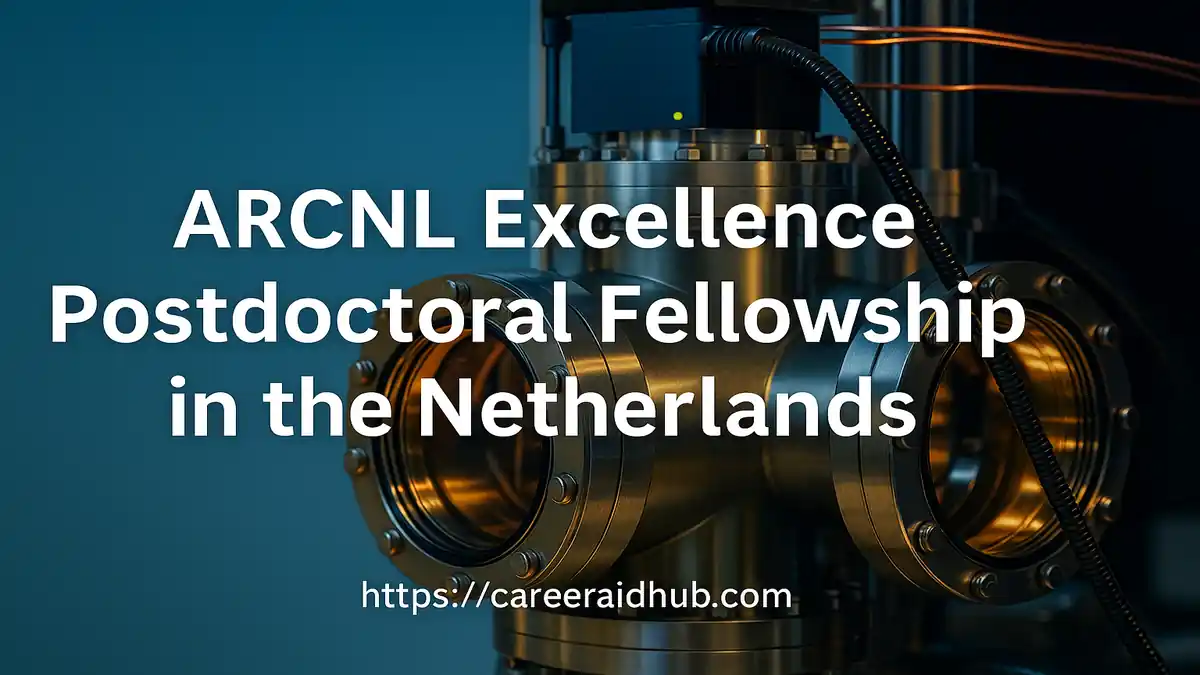
ARCNL Excellence Postdoctoral Fellowship in the Netherlands: Complete Guide for Physicists
The ARCNL Excellence Postdoctoral Fellowship in the Netherlands is a premium opportunity for outstanding young researchers in physics and related fields who want to work at the interface of fundamental science and cutting-edge semiconductor technology. Hosted by the Advanced Research Center for Nanolithography (ARCNL) in Amsterdam, this fellowship offers a highly competitive package, world-class labs and a direct link to industry leader ASML.
In this guide, you will find an overview of the programme, key benefits, eligibility criteria, funding details, the step-by-step application process, and practical advice to help you submit a strong proposal.
Introduction to the ARCNL Excellence Postdoctoral Fellowship
ARCNL is a public–private research centre that focuses on the fundamental physics and chemistry behind nanolithography, with strong emphasis on extreme ultraviolet (EUV) light sources, nanophotonics, materials science and metrology for semiconductor manufacturing.
The ARCNL Excellence Postdoctoral Fellowship is designed to:
-
-
Attract outstanding postdoctoral researchers from outside ARCNL
-
Support pioneering research in collaboration with both academia and high-tech industry
-
Accelerate the career development of
talented physicists and engineers
Selected fellows develop and execute their own project within one of ARCNL’s research groups, working closely with senior scientists and industrial partners.
Why the ARCNL Excellence Postdoctoral Fellowship Matters
Direct bridge between academia and industry
Semiconductor manufacturing is a strategic global industry. ARCNL sits right in the middle of this ecosystem, as a partnership between the Dutch Research Council (NWO), the University of Amsterdam, Vrije Universiteit Amsterdam, the University of Groningen and ASML.
Therefore, fellows gain:
-
-
Access to real-world challenges in lithography and nanometrology
-
Regular interaction with ASML scientists and engineers
-
A CV that speaks to both academic and industrial employers
For early-career researchers, especially those interested in applied physics or photonics, this combination is rare and highly valuable.
Excellent environment for postdoctoral research in nanolithography
ARCNL is organised into three departments: Source, Metrology and Materials. Research topics include:
-
-
EUV generation and plasma physics
-
High-harmonic generation and ultrafast nanophotonics
-
Nanoscale imaging and metrology
-
Materials and surface science for EUV lithography
Fellows therefore work in a dense cluster of
expertise with access to advanced lasers, vacuum systems, cleanrooms and highly specialised diagnostics.
Eligibility: Who Is the Fellowship For?
According to the official call, ARCNL welcomes highly talented and motivated candidates who meet the following criteria:
-
-
Hold a PhD in physics or a related field, or will obtain their PhD within one year after the application deadline
-
Have an excellent academic and publication record
-
Are self-driven and creative, able to conduct independent research at a high level
-
Demonstrate strong analytical, experimental and/or computational skills
-
Possess excellent scientific writing and communication skills
-
Enjoy working in teams and across disciplines
-
Show potential to supervise MSc/PhD students and manage a project
For international applicants (including Indian researchers)
ARCNL explicitly invites applications from researchers outside ARCNL, and its working-abroad resources support international hires with relocation and integration.
For candidates from India and other regions, this makes the ARCNL Excellence Postdoctoral Fellowship a strong option if you:
-
-
Want a postdoc in Europe with high-impact applied physics
-
Aim to move between academia and industry later in your career
-
Prefer an English-speaking, international research environment
Key
Features, Funding and Working Conditions
The fellowship offers conditions that are competitive within the Dutch research system and aligned with sectoral agreements. While exact salary scales are not detailed in the advertisement, ARCNL highlights:
-
-
Competitive salary and full-time employment
-
Two-year contract, with the possibility of a one-year extension after positive evaluation
-
World-class equipment and research infrastructure
-
Ambitious, collaborative scientific environment
-
Strong links to ASML and other partners in the Dutch innovation ecosystem
As an ARCNL employee, you also benefit from the Dutch system’s social security, pension contributions, paid leave and access to international schools and public services in Amsterdam.
Research Areas and Possible Projects
Fellows select a research topic in alignment with an ARCNL group. The main research lines include:
-
-
Source physics and EUV plasma processes – generation and optimisation of EUV light
-
Metrology and imaging – ultrafast soft X-ray metrology, high-harmonic metrology and nanometrology
-
Materials and surfaces – contact dynamics, surface chemistry and materials theory for EUV optics
Within these themes, you might:
justify;">
Design new diagnostics for EUV light sources
Develop ultrafast spectroscopy methods for semiconductor wafers
Model laser-plasma interaction for next-generation lithography tools
The fellowship is therefore ideal if you want to design your own project at the intersection of advanced optics, plasma physics and semiconductor technology.
Step-by-Step: How to Apply
The application process for the ARCNL Excellence Postdoctoral Fellowship is clearly structured on the official page.
1. Identify your research topic and group
First, visit the ARCNL research pages and explore the different departments and group leaders. Choose the group whose expertise best matches your background and interests.
2. Contact the group leader
Next, contact the relevant group leader by email to discuss a preliminary project idea. This step helps you:
3. Develop your project proposal
You then develop a 2-page project proposal in consultation with the group leader. According to the call, the proposal should outline:
-
-
Scientific background and motivation
-
Research objectives and key questions
-
Methodology and experimental or modelling approach
-
Expected impact and relevance for nanolithography
4. Prepare application documents
A complete application includes:
-
-
Curriculum Vitae, including contact details for three referees
-
List of publications
-
2-page project proposal
-
1-page motivation letter explaining why this group, why ARCNL and why this research
5. Submit online before the deadline
Applications are submitted through the ARCNL online application system via the job page. The current deadline is 31 January 2026, followed by online interviews in February and on-site interviews in March. Final decisions are expected by late March or April.
Tips, Common Mistakes and Expert Advice
1. Treat the proposal as a mini-grant
You are not just applying for a job; you are pitching a small research grant inside ARCNL. Therefore:
-
-
Articulate a clear problem and why it matters
-
Show awareness of the state of the art
-
Explain why ARCNL is the right place to tackle it
2. Balance ambition and feasibility
Reviewers appreciate bold ideas, but they also look for realistic plans. Make sure your objectives, methods and timeline can fit into a two- to three-year fellowship.
3. Show how you complement the host group
Do not simply repeat the group’s current projects. Instead, show how your skills, methods or ideas add something new while still fitting the group’s direction.
4. Use the motivation letter wisely
Avoid generic statements like “I am passionate about physics.” Instead, link specific experiences—your PhD work, a key publication, a previous collaboration—to the ARCNL environment and the proposed project.
5. Prepare referees and interview strategy
Inform your referees early and share your proposal with them. For the interview stage, be ready to:
-
-
Discuss technical details clearly
-
Explain how you would handle setbacks in the project
-
Reflect on your career plans beyond the fellowship
For international applicants, including those from India, it also helps to demonstrate that you understand what living and working in the Netherlands involves and that you are ready for the move.
Conclusion: Is the ARCNL Excellence Postdoctoral Fellowship Right for You?
The ARCNL Excellence Postdoctoral Fellowship in the Netherlands is a powerful stepping stone for early-career physicists who want to operate at the frontier of nanolithography and semiconductor research. It combines competitive funding, advanced laboratories, industry-linked projects and a collaborative environment in the heart of Amsterdam’s Science Park.
If you have a strong PhD track record, enjoy designing your own experiments or simulations, and want close contact with both academia and industry, this programme deserves serious attention. Start by exploring ARCNL’s research groups, shaping a focused project idea and reaching out to potential supervisors well before the deadline.
For full, up-to-date information, always consult the official ARCNL Excellence Postdoctoral Fellowship page and the ARCNL careers portal. Consider bookmarking this guide and sharing it with colleagues who may also be ready for this level of challenge and opportunity.
Programme Summary Table
| Feature |
Details |
| Program Name |
ARCNL Excellence Postdoctoral Fellowship |
| Host Country |
The Netherlands (Science Park, Amsterdam) |
| Funded By |
Advanced Research Center for Nanolithography (ARCNL) with public–private partners including NWO, University of Amsterdam, VU Amsterdam, University of Groningen and ASML |
| Duration |
Two-year contract with possible one-year extension upon positive evaluation |
| Study Mode |
Full-time, on-site postdoctoral research |
| Eligibility |
PhD in physics or related field (or within one year of completion), excellent publication record, strong research skills, teamwork and communication abilities |
| Financial Support |
Competitive salary under Dutch academic scales; full-time employment; access to world-class labs and infrastructure; career development support |
| Fields of Study |
Physics and related disciplines linked to nanolithography: EUV sources, ultrafast optics, nanophotonics, metrology, materials and surface science |
| Deadline |
31/01/2026 (current call; future calls may vary) |
| Official Website |
ARCNL Excellence Postdoctoral Fellowship |
Frequently Asked Qsuestion
Is the ARCNL Excellence Postdoctoral Fellowship open to all nationalities? Yes. The fellowship welcomes exceptional researchers from any country, as long as they meet the academic and experience requirements and can relocate to Amsterdam.
What is the duration of the ARCNL Excellence Postdoctoral Fellowship? The initial contract is for two years, with the possibility of a one-year extension after a positive evaluation of your performance and project progress.
Which background is preferred for this ARCNL postdoc fellowship? ARCNL targets candidates with a PhD in physics or a closely related field, such as applied physics, physical chemistry, optics, photonics or materials science relevant to nanolithography.
Do I need Dutch language skills to apply? No. English is the working language at ARCNL and in most Dutch research institutes. However, learning some Dutch can help with daily life and integration.
Can I propose a purely theoretical project? Yes, theoretical or computational projects are possible, provided they align with ARCNL’s research themes and you demonstrate strong modelling or numerical skills relevant to lithography problems.
Is there support for coming from abroad? ARCNL and its partner institutions provide guidance on visas, housing and relocation matters through their “Coming from abroad” resources and HR support.
Premium Mentorship for a Stronger Application
- Premium Mentorship: personalised 1:1 guidance for this and similar opportunities
- In-depth review of your CV, academic profile, and key statements
- Aligned with international selection criteria so your profile matches what panels expect
- Stronger, more compelling narrative for highly competitive calls
- Step-by-step support from opportunity mapping to final submission (fee-based)
Subscribe Premium Mentorship