Introduction: A Focused Postdoc Opportunity in Causal Learning and AI
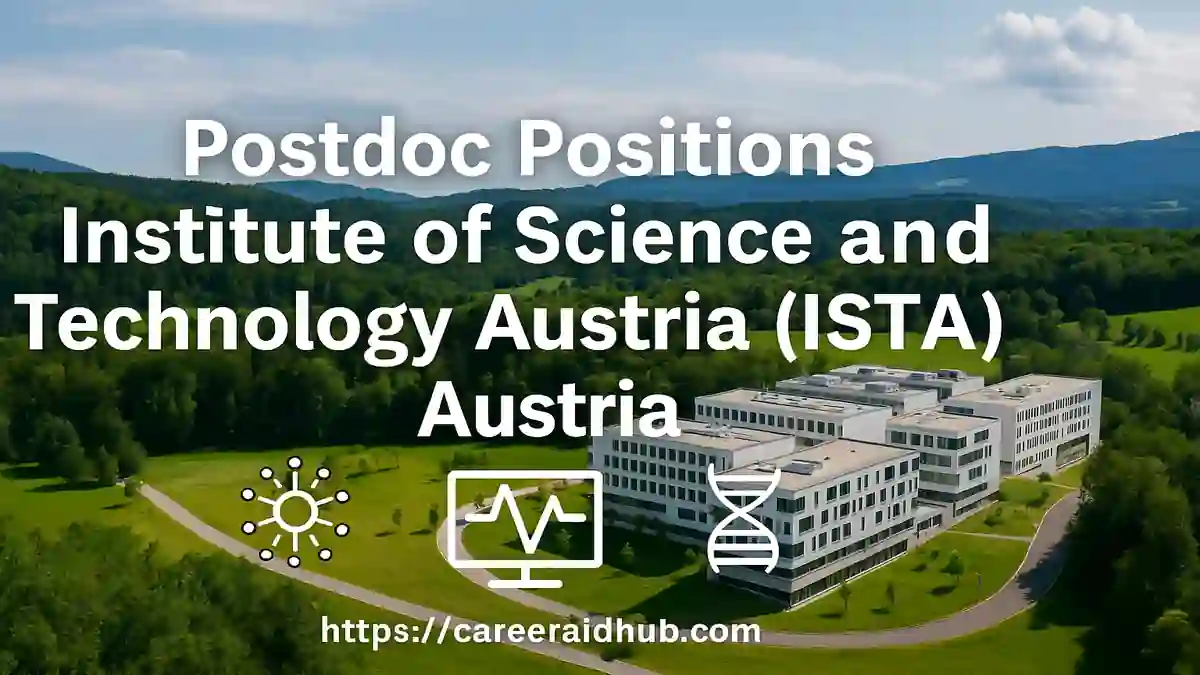
The postdoc research positions Institute of Science and Technology Austria (ISTA) are attracting strong attention from early-career researchers in machine learning and AI for science. This article explains what the position offers, who should apply, and how to prepare a competitive application. It also places the role in the wider ISTA postdoc ecosystem so that you can decide whether this is the right next step for your research career.
One of the most exciting current openings is the Postdoctoral Researcher role in the Locatello Group, which focuses on causal representation learning and its applications across scientific domains.
Why Postdoc Research Positions at ISTA Matter
ISTA is a highly international research institute near Vienna that combines independent basic research with graduate education. It hosts dozens of research groups across mathematics, computer science, life sciences and physical sciences, with a strong emphasis on cross-disciplinary collaboration.
For postdocs, this environment offers several advantages. First, you work in small, focused groups led by tenure-track or tenured professors, which means direct mentorship and real influence on research direction. Secondly, the institute
Within this context, the Locatello Group provides a rare chance to shape the future of causal learning and AI for science while embedded in an ecosystem that values long-term, curiosity-driven research.
About the Locatello Group and the Open Postdoc Position
The Locatello Group at ISTA studies how to move beyond pattern recognition and towards models that understand cause and effect. Modern machine learning often works well only when conditions stay fixed; it struggles with interventions, domain shifts and temporal structure. This group tackles those weaknesses by learning causal representations and robust causal models from data.
As a postdoctoral researcher in causal learning at ISTA, you will:
-
- Develop new theory and algorithms for causal representation learning.
- Work on foundational questions in causality and machine learning.
- Apply your methods to scientific domains such as biology, ecology and climate science.
- Lead projects and mentor PhD students in the group.
- Collaborate with a wider network of researchers across ISTA.
The position is full-time, based in Klosterneuburg (near Vienna), and currently offers a gross annual salary of around €72,100, with potential overpayment depending on
Eligibility and Ideal Candidate Profile
Core Academic Requirements
The Locatello Group is seeking a candidate with a strong background in causality and machine learning. According to the official job description, you should meet the following core criteria:
-
- Completed PhD in machine learning, statistics, or a closely related discipline.
- Strong publication record in top venues such as NeurIPS, ICML, ICLR, AISTATS or CVPR.
- Ability to conduct independent research and contribute to team projects.
- Excellent command of English, which is the working language on campus.
Interdisciplinary experience is not formally required; however, a genuine interest in applying AI to scientific problems is essential.
Who This Position Is For
This postdoc research position at ISTA is particularly suitable if:
-
- You have just completed, or are close to completing, a PhD in ML, statistics, or a related area.
- Your work already touches causal inference, representation learning, robustness, or distribution shifts.
- You want to see your algorithms impact domains such as biology or environmental science.
- You enjoy mentoring students and shaping a young research group’s agenda.
If you are mainly interested in short-term industrial
Key Features, Funding and Benefits
Position Structure and Funding
The Locatello postdoc is fully funded for two years, with the option to extend, and is embedded in the FWF Cluster of Excellence on Bilateral AI.
This cluster funding adds several advantages:
-
- Stable financial support for high-risk, high-reward ideas.
- Connections to a broader network of researchers working on Bilateral AI.
- Additional opportunities for joint projects and workshops.
More broadly, ISTA can appoint postdoctoral fellows for periods of up to five years, depending on group needs and funding.
Campus Environment and Benefits
ISTA emphasises a supportive work environment. As a postdoc, you benefit from:
-
- Career development training and workshops.
- Access to state-of-the-art facilities for computing and experiments.
- On-campus cafeteria and social spaces.
- Childcare support and family-friendly services.
- Free shuttle bus from Vienna to the campus.
- Health initiatives and pension insurance.
Additionally, the ISTA Postdoctoral Office and Postdoc Association offer
How to Apply for ISTA Postdoc Research Positions
Step 1: Study the Official Job Page
First, carefully read the official job posting for the Locatello Group postdoc (link given below)
Pay attention to the responsibilities, profile and benefits, and note the application instructions and any implicit expectations in the text.
Step 2: Prepare the Required Documents
The job description specifies the following application documents:
-
- Cover letter.
- Curriculum vitae.
- Publication list.
- Contact details for three references.
In your cover letter, explain why your work fits causal learning, highlight key papers, and describe how you want to contribute to the group’s themes. In the CV, structure your publications by type and venue so that NeurIPS/ICML/ICLR-level work is immediately visible.
Step 3: Contact the Group Leader
For this specific position, you submit your application by email directly to [email protected], as indicated on the official page.
You should write a concise, professional email, attach the required documents, and mention possible starting dates. If you have a clear idea for a project, briefly outline it in one or two paragraphs.
Step 4: Explore Additional ISTA Postdoc Routes
If you are also considering other postdoctoral research positions at ISTA, you can:
- Browse open positions via the ISTA jobs portal.
- Review the general Postdocs page for background on appointments and expectations.
- Consider the NOMIS-ISTA Fellowship and ISTA-Fellow programs if your profile matches their criteria.
Expert Tips, Common Mistakes and Strategic Advice
Highlight Depth, Not Just Breadth
Selection committees for high-profile postdoc research positions Institute of Science and Technology Austria look for depth. It is tempting to list every project you have touched, yet it is more effective to highlight a coherent research line.
Therefore, choose three or four core contributions and explain how they relate to causal learning, representation learning, or robust ML.
Connect to AI for Science
The Locatello Group wants to “revolutionize other scientific areas with AI.”
Consequently, you should demonstrate that you can think beyond benchmark datasets. For example, briefly discuss how your methods could help in climate modelling, single-cell biology, or ecological forecasting. You do not need full domain expertise; you do need curiosity and a willingness to collaborate.
Avoid These Common Pitfalls
Several mistakes recur in competitive postdoc calls:
-
- Generic cover letters that could have been sent to any ML group.
- Over-claiming impact without clear evidence from publications or code.
- Poorly formatted publication lists, making it hard to see top-tier venues.
- Neglecting to mention how you plan to mentor students or contribute to group life.
Additionally, some applicants underestimate the importance of reference letters. Choose referees who know your work in detail and can speak to your independence, creativity and team skills.
Conclusion: Is the ISTA Postdoc in the Locatello Group Right for You?
The postdoc research positions Institute of Science and Technology Austria, and particularly the Locatello Group role, offer a powerful platform if you want to work at the intersection of causal learning, representation learning and AI for science. You gain access to a well-funded, interdisciplinary environment with strong support structures, competitive salary, and a clear expectation of scientific excellence.
If your research already engages with causality, robustness, or model interpretability, this position can significantly accelerate your trajectory. Moreover, it prepares you well for future careers in academia, research institutes, or high-end industrial labs with a strong fundamental research agenda.
Prospective applicants should now review the official ISTA pages, refine their research narrative, and reach out with a focused, well-documented application. Early, thoughtful preparation is often the difference between a good application and a truly compelling one.
Summary Table
|
Feature |
Details |
|
Program Name |
Postdoctoral Researcher – Locatello Group, Institute of Science and Technology Austria (ISTA) |
|
Host Country |
|
|
Funded By |
ISTA and FWF Cluster of Excellence on Bilateral AI |
|
Duration |
Two years, with possibility of extension |
|
Study Mode |
Full-time, on-campus research position (40 h/week) |
|
Eligibility |
PhD in machine learning, statistics or related field; strong publication record; excellent English; ability to work independently and in a team |
|
Financial Support |
Approx. €72,100 gross/year, with possible overpayment, plus institutional benefits (training, childcare, shuttle, health offers, pension) |
|
Fields of Study |
Causal learning, causal representation learning, machine learning, AI for science (e.g., biology, ecology, climate) |
|
Deadline |
Varies / Not announced explicitly; candidates should check the current job posting date and apply promptly |
|
Official Website |
References
Reference 1: Postdocs at ISTA – official overview of postdoctoral appointments, fellowships and support structures at the Institute of Science and Technology Austria.
Frequently Asked Questions (FAQs)
The postdoc focuses on causal learning and modern machine learning, with applications to scientific domains such as biology, ecology and climate-related problems.
You need a PhD in machine learning, statistics or a closely related field, as long as your research record demonstrates strong competence in relevant topics.
Your publication record is crucial. The group expects strong papers in leading venues such as NeurIPS, ICML, ICLR, AISTATS or CVPR, supported by clear technical contributions.
Yes. Interdisciplinary experience is not required; however, you should show genuine interest in collaborating with scientists from other fields and applying AI methods to real data.
The contract is initially for two years and may be extended, depending on funding, performance and mutual agreement between you and the group leader.
The advertised salary is around €72,100 gross per year, with the possibility of higher pay depending on qualifications and experience, plus additional institutional benefits.
You prepare a cover letter, CV, publication list and referee contacts, then email your complete application directly to [email protected] as stated on the job page.
Yes. You can explore additional postdoc vacancies and fellowship schemes on the ISTA jobs and postdocs pages and apply separately where your profile fits the advertised roles.
Premium Mentorship for a Stronger Application
- Premium Mentorship: personalised 1:1 guidance for this and similar opportunities
- In-depth review of your CV, academic profile, and key statements
- Aligned with international selection criteria so your profile matches what panels expect
- Stronger, more compelling narrative for highly competitive calls
- Step-by-step support from opportunity mapping to final submission (fee-based)