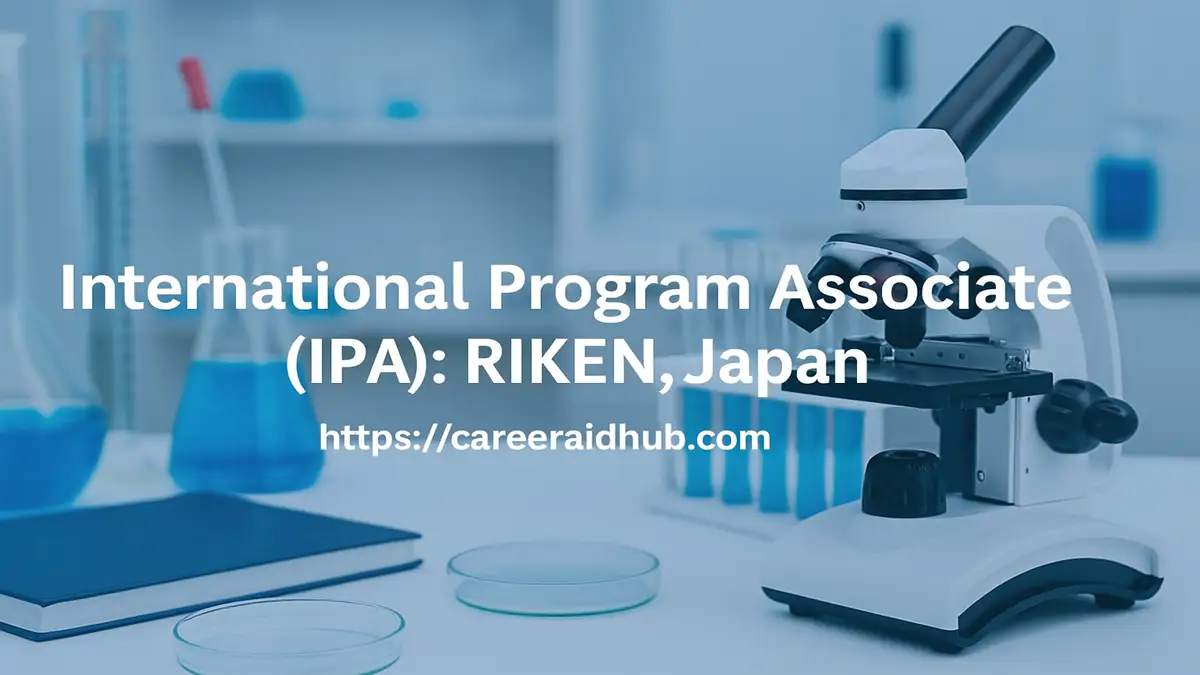
International Program Associate RIKEN Japan

International Program Associate research opportunity at RIKEN Japan for global early-career scientists and PhD graduates

Introduction

The International Program Associate RIKEN Japan scheme is one of the most attractive routes for non-Japanese PhD candidates who want to work in a world-class research environment while completing their doctorate. In this guide, you will learn how the International Program Associate (IPA) program works, who can apply, what kind of financial support is available, and how to plan a competitive application. The article is written for international PhD students, including those from India and other emerging research economies who are aiming for funded research opportunities in Japan.

The program allows selected doctoral students from partner universities to conduct part of their thesis research at RIKEN, Japan’s flagship institute for basic and applied science.

Why the International Program Associate RIKEN Japan Program Matters

RIKEN is one of the most respected research organisations in Asia, with major strengths in physics, chemistry, computational science, life sciences and medical research. Through the IPA program, RIKEN collaborates with selected Japanese and overseas universities to create a joint graduate school framework. Within this framework, IPA students carry out research at RIKEN under the supervision of a RIKEN principal investigator while remaining enrolled in their home PhD program.

For early-stage researchers, this arrangement offers several advantages:

    • Access to cutting-edge laboratories and large-scale facilities.
    • Daily interaction with leading scientists and an international peer group.
    • Strong visibility for future postdoctoral applications in Japan and worldwide.
    • Financial support that covers living costs and accommodation, which significantly reduces personal financial pressure.

Moreover, the IPA route is particularly valuable for students whose home universities already collaborate with RIKEN. It deepens institutional partnerships and helps doctoral candidates build binational or multinational research careers.

Eligibility and Who the IPA Program Is For

Core eligibility criteria

According to RIKEN’s official description, an International Program Associate must:

    • Be a non-Japanese doctoral candidate.
    • Be enrolled in a PhD program at a Japanese or overseas university that has signed, or is in the process of signing, a joint graduate school partnership with RIKEN.

In practice, most successful applicants also:

    • Hold a relevant master’s degree in a science or engineering field.
    • Have a clearly defined research project that aligns with one of RIKEN’s laboratories.
    • Demonstrate strong academic performance and some research outputs, such as conference papers or early publications.

Suitable disciplines

The program covers a wide range of

areas, including physics, chemistry, biology, medical science, engineering and computational sciences. This breadth makes the RIKEN IPA program attractive both for experimental researchers and for those working in theory, modelling or data-intensive fields.

Who benefits most

The International Program Associate RIKEN Japan program is especially suitable for:

    • PhD students who want long-term research exposure in Japan (one to three years).
    • Candidates whose thesis projects would benefit from specialised equipment or large datasets available at RIKEN.
    • Students aiming for future postdoctoral positions in Japan, including at RIKEN itself.

Key Features, Funding and Duration

Duration of the appointment

IPA positions normally run from one to three years. This period is counted as part of the candidate’s doctoral program and is usually aligned with the home university’s doctoral timeline.

Financial support

One of the biggest attractions of the International Program Associate RIKEN Japan scheme is its financial package. Based on RIKEN and partner-lab information, IPAs typically receive:

    • A daily living allowance (for example, around 5,200 JPY per working day in some collaborations).
    • Free on-campus housing or reimbursement of rent for off-campus accommodation up to a defined ceiling (often around 70,000 JPY per month).
    • In some cases, one round-trip
      airfare
      between the student’s home country and Japan.
    • Exact amounts and conditions may vary across RIKEN centres and partner universities, so candidates should confirm details with their prospective supervisor and local graduate office.

Research environment

IPA students work full-time in RIKEN laboratories and are integrated into the host research group. They participate in group meetings, seminars and collaborations, while maintaining formal registration at their home university. Many groups operate in English, and RIKEN campuses often offer Japanese language classes to support daily life.

Step-by-Step: How to Apply for the RIKEN IPA Program

Although the exact process differs by partner institution, a typical pathway to the International Program Associate RIKEN Japan program includes the following steps.

  1. Check whether your university is a partner

First, confirm that your current or planned PhD university has a joint graduate school agreement with RIKEN. The official IPA page lists many Japanese and overseas partners in Asia, Europe and beyond. If your institution is not listed but has active research links with RIKEN, it may still be possible to initiate an agreement through your supervisor or international office, though this takes time.

start="2">
  • Identify a RIKEN host laboratory

  • Next, explore RIKEN’s research centres and laboratories to find a group that matches your scientific interests. Read recent publications, lab webpages and project descriptions. Prepare a concise research outline explaining how your current PhD project can be advanced through a stay at that lab.

    1. Contact a potential RIKEN supervisor

    Most partner-university guidelines emphasise that the first formal step is establishing contact with a RIKEN principal investigator who is willing to host you. Some units, such as AIDA at the University of Tokyo, explicitly state that applications should include confirmation from a RIKEN researcher agreeing to supervise the student.

    When writing to a potential supervisor:

      • Introduce your research background and current PhD topic.
      • Explain why their lab is a good fit.
      • Attach a CV, transcript and a short research summary.
    1. Follow your university’s internal procedures

    In many cases, application documents are submitted to RIKEN through the home university or through the host PI, not directly by the student. Their administrative offices coordinate nomination, eligibility checks and document transfer to RIKEN’s personnel section.

    1. Observe application periods

    Some RIKEN centres accept IPA candidates twice per year, often around April and autumn (September or October). However, deadlines vary across partner universities and laboratories. Therefore, you should verify the precise schedule with both your home institution and the intended RIKEN host.

    Practical Tips, Common Mistakes and Expert Advice

    Strengthen the research fit

    Selection committees look for candidates whose projects clearly align with ongoing work at RIKEN. To increase your chances:

      • Map your PhD objectives to specific techniques, facilities or datasets available at RIKEN.
      • Show how the collaboration will benefit both groups, not only your own CV.
      • Highlight any prior joint work, such as co-authored abstracts or short visits.

    Prepare documents early

    Most IPA calls require:

      • Curriculum vitae with publications and awards.
      • Academic transcripts.
      • A research proposal or summary.
      • Letters from your home supervisor and RIKEN host.

    Collecting and coordinating these documents often takes several months, especially when multiple institutions are involved. Starting early reduces last-minute stress.

    Avoid these common mistakes

    Applicants sometimes weaken their case by:

      • Sending generic emails to many RIKEN labs without reading their research.
      • Ignoring the requirement that they must already be enrolled, or planning to enrol, in a partner university PhD program.
      • Underestimating the importance of supervisor endorsement from both sides.

    Think beyond the IPA period

    The International Program Associate RIKEN Japan experience can be a powerful stepping stone. Plan how you will leverage it by:

      • Targeting joint publications before your IPA term ends.
      • Presenting your RIKEN work at international conferences.
      • Keeping contact with mentors who can support your future postdoc or faculty applications.

    Summary Table

    Feature Details
    Program Name

    International Program Associate (IPA)

    Host Country Japan
    Funded By RIKEN
    Duration Typically 1–3 years, depending on doctoral plan
    Study Mode Full-time research at RIKEN while enrolled in a partner university PhD program
    Eligibility Non-Japanese PhD candidates enrolled in universities with a joint graduate school agreement with RIKEN
    Financial Support Daily living allowance, housing support, and in some schemes a round-trip airfare (exact terms vary by lab and partner)
    Fields of Study Broad areas including physics, chemistry, biology, medical science, engineering and computational science
    Deadline

    Varies by partner university; often two intakes per year (spring and autumn). Check official website for current schedule

    Official Website Click here

    Conclusion

    The International Program Associate RIKEN Japan program offers an exceptional opportunity for non-Japanese PhD candidates to conduct high-impact research in a premier scientific institution. By combining the academic framework of a home university with the resources and mentoring available at RIKEN, IPA students can accelerate their doctoral projects and expand their international networks.

    For motivated researchers, especially from countries with growing research ecosystems such as India, participation in the IPA program can serve as a launchpad toward competitive postdoctoral fellowships and long-term collaborations with Japanese and global partners. If the program aligns with your research goals, start by mapping your project to suitable RIKEN labs, contacting potential supervisors, and discussing the joint graduate school pathway with your university.

    Finally, keep visiting the official IPA information pages and your university’s international office updates to track upcoming calls and evolving requirements. Early preparation, clear communication and a strong scientific proposal will give you the best chance of turning this unique opportunity into a defining chapter of your research career.

    Premium Mentorship for a Stronger Application

    • Premium Mentorship: personalised 1:1 guidance for this and similar opportunities
    • In-depth review of your CV, academic profile, and key statements
    • Aligned with international selection criteria so your profile matches what panels expect
    • Stronger, more compelling narrative for highly competitive calls
    • Step-by-step support from opportunity mapping to final submission (fee-based)
    Subscribe Premium Mentorship
    Scroll to Top